AestheFill in Dubai — Next-Gen PDLLA Collagen Stimulator
What if your skin could rebuild its own collagen from within — producing natural volume, firmness, and elasticity that lasts up to two years? AestheFill makes this possible. A next-generation PLA collagen stimulator in Dubai composed of poly-D,L-lactic acid (PDLLA) porous microspheres, manufactured by REGEN Biotech in South Korea, AestheFill represents the evolution of collagen-stimulating injectables.
Its unique sponge-like microsphere structure allows collagen to grow both around and inside each particle — delivering progressive, natural-looking rejuvenation.
- PDLLANext-Gen Biostimulator
- 24moResults Up To
- FDASubstance Approved
- 2,200standard 2,500
AestheFill in Dubai — Next-Gen PDLLA Collagen Stimulator at a glance
AestheFill in Dubai by Dr Azra Vaziri — PDLLA collagen biostimulator for gradual, natural volume and firmer skin lasting up to 24 months.
- Next-Gen Biostimulator
- PDLLA
- Results Up To
- 24mo
- Substance Approved
- FDA
- standard 2,500
- 2,200
From AED 2,200 · Performed by Dr Azra Vaziri at Prof Sakla Spanish Eye Clinic, Dubai
Porous Microsphere Technology
PDLLA’s unique sponge-like microspheres let collagen grow both around and inside each particle — more surface area, more collagen, more natural results
Quick answer
What is AestheFill? AestheFill is a PDLLA (poly-D,L-lactic acid) collagen stimulator. It gradually rebuilds your own collagen for natural volume and improved skin quality over 6–12 weeks, lasting up to two years — a different, longer-acting mechanism from standard HA fillers. From AED 2,200
Personalised treatments by Dr Azra Vaziri in Dubai. See biostimulator pricing.
⎯ Understanding the Treatment
What Is AestheFill?
AestheFill is a next-generation injectable biostimulator composed of poly-D,L-lactic acid (PDLLA) porous microspheres, manufactured by REGEN Biotech in South Korea, that stimulates your body’s own collagen production for progressive, natural-looking facial rejuvenation lasting 18 to 24 months.
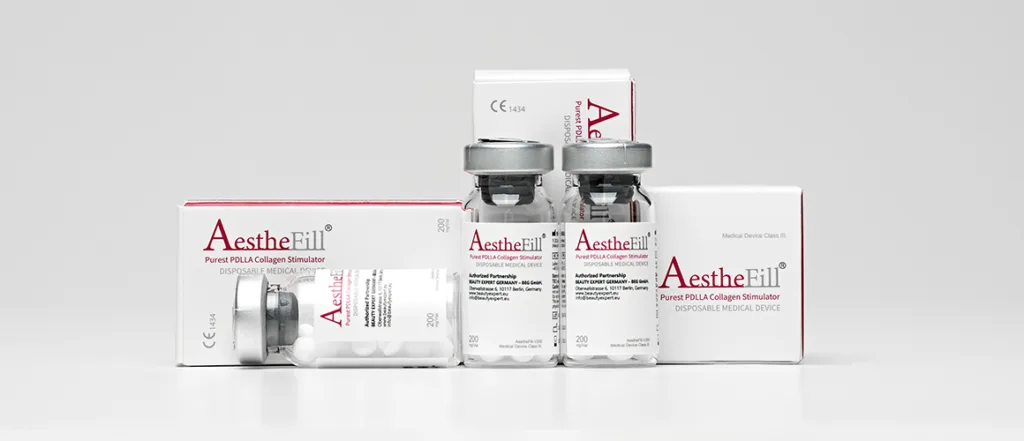
Unlike traditional dermal fillers that simply fill space, AestheFill works by triggering biological regeneration. The product is supplied as a lyophilized (freeze-dried) powder containing 200mg of PDLLA microspheres in a sodium carboxymethylcellulose (CMC) carrier. Before injection, it is reconstituted with sterile water to create a smooth, injectable suspension.
What makes AestheFill fundamentally different from other biostimulators is its microsphere architecture. While Sculptra’s PLLA microparticles are solid and irregular, AestheFill’s PDLLA microspheres are perfectly spherical and porous — featuring multiple micropores that create a sponge-like internal structure. This porosity allows fibroblasts to migrate not only around the microspheres but also inside them, creating a three-dimensional scaffold for collagen production. The result is more surface area for cellular activity and a more uniform collagen matrix.
PDLLA is an amorphous polymer — meaning it degrades more evenly and predictably than crystalline PLLA. The microspheres are naturally biodegraded by the body into water and carbon dioxide over 3 to 6 months, leaving behind only the new collagen, elastin, and hyaluronic acid your body has produced. This collagen maintains the volume and skin quality improvements for 18 to 24 months. PDLLA has been FDA-substance approved since 1984 and has been used in surgical sutures, drug delivery systems, and medical devices for over three decades.
AestheFill belongs to the polylactic acid biostimulator family alongside Sculptra and Radiesse (CaHA). Dr Azra uses AestheFill as part of her broader regenerative aesthetics approach, often combining it with Profhilo, Botox, polynucleotide therapy, skin boosters, or thread lifting for comprehensive facial rejuvenation. For a detailed breakdown, see our biostimulators vs dermal fillers guide.
Porous Microspheres
Unique sponge-like PDLLA particles with micropores allow 3D collagen growth both around and inside each microsphere — more surface area than solid particles
Up to 24 Months
Progressive collagen stimulation builds over 2–3 sessions, with results lasting 18 to 24 months — among the longest-lasting biostimulators available
100% Biocompatible
PDLLA is fully biodegradable — broken down into water and CO₂. FDA-substance approved since 1984. Used in medical sutures for 30+ years. No allergy testing required
Lower Complication Rate
Clinical studies show PDLLA has a lower complication rate compared to PLLA, with shorter reconstitution time and more predictable degradation profile
⎯ The Science
How AestheFill Works — Porous PDLLA Biostimulation
AestheFill’s effectiveness comes from its unique porous microsphere architecture and the biological cascade it triggers. Understanding this mechanism explains why results are progressive, natural, and remarkably long-lasting.
When AestheFill is injected into the deep dermis or subcutaneous layer, the reconstituted suspension initially provides some mechanical volume from the water and CMC carrier. Over the first week, this carrier fluid is absorbed and the initial volume reduces slightly — this is normal and expected.
What remains are the PDLLA microspheres themselves. Unlike solid PLLA particles, AestheFill’s microspheres are porous with multiple micropores measuring 20 to 50 micrometres. Fibroblasts — the cells responsible for producing collagen — migrate to these microspheres and begin attaching to their surfaces. Because of the porous structure, cells also migrate inside the microspheres, effectively colonising them from within. This creates a three-dimensional scaffold where collagen forms not just around each particle but throughout its interior.
Over the following weeks and months, the activated fibroblasts produce new type I and type III collagen, elastin, and even hyaluronic acid. The PDLLA microspheres themselves are gradually biodegraded by hydrolysis into lactic acid, then further into water and carbon dioxide — completely harmless end products that the body eliminates naturally. This degradation takes approximately 3 to 6 months. What remains is entirely your own newly produced collagen matrix — maintaining the volume restoration and skin quality improvements for 18 to 24 months.
Clinical evidence: Animal studies by Lin et al. confirmed neotissue formation around and inside PDLLA microspheres with no migration, inflammation, or abnormal findings over 20 weeks. Comparative studies (Chen, Lin & Lin) demonstrated that PDLLA’s amorphous structure degrades more predictably than crystalline PLLA, with a shorter reconstitution time and lower complication rate. Published research shows PDLLA’s porous microspheres provide earlier volume retention compared to solid PLLA microparticles due to their higher total volume.
Injection & Initial Volume
The reconstituted PDLLA suspension is injected into the deep dermis. The carrier fluid provides some initial mechanical volume. Over the first week, this carrier absorbs and volume settles — this is expected.
3D Collagen Scaffold Formation
Fibroblasts colonise the porous microspheres from outside and inside, creating a three-dimensional collagen scaffold. New type I and III collagen, elastin, and hyaluronic acid production begins — building natural volume progressively.
Natural Biodegradation & Lasting Results
Over 3–6 months, PDLLA is naturally biodegraded into water and CO₂. The collagen matrix your body has built remains — maintaining volume, firmness, and skin quality for 18–24 months. Maintenance builds on accumulated collagen year over year.
⎯ Patient Journey
AestheFill Results Timeline — What to Expect
AestheFill results build progressively over 2–3 sessions and last 18 to 24 months. Because collagen stimulation is gradual, understanding the timeline helps set realistic expectations for this transformative treatment.
- D1
Day of Treatment
Some initial volume visible from the reconstituted suspension.
Read moreShow less
Mild swelling and redness are normal. The session takes 30–60 minutes. Most patients return to their day within an hour.
- W1
Week 1–2
Carrier fluid absorbs and initial volume reduces slightly
Read moreShow less
— this is normal and expected. The porous microspheres remain at the injection site. Fibroblasts begin attaching. Follow the massage protocol as instructed.
- S2
Session 2 (Week 4–6)
Second treatment session reinforces the collagen stimulation.
Read moreShow less
By now, early collagen production from the first session is beginning. Volume starts building naturally. A third session may be scheduled if needed.
- M2
Month 2–3
Full collagen production is underway. Volume becomes more noticeable.
Read moreShow less
Skin feels firmer, thicker, and more resilient. This is when patients typically see the most dramatic improvement — natural volume that looks and feels like your own tissue.
- M6
Month 6–24
PDLLA microspheres are fully biodegraded. What remains is entirely your own collagen.
Read moreShow less
Volume and skin quality are maintained for 18–24 months. Results fade gradually and naturally — not suddenly. Annual maintenance extends benefits.
- ↻
Annual Maintenance
A single maintenance session per year sustains your collagen foundation.
Read moreShow less
With each cycle, you build on previously accumulated collagen — meaning subsequent treatments often require fewer vials. Your skin keeps improving year over year.
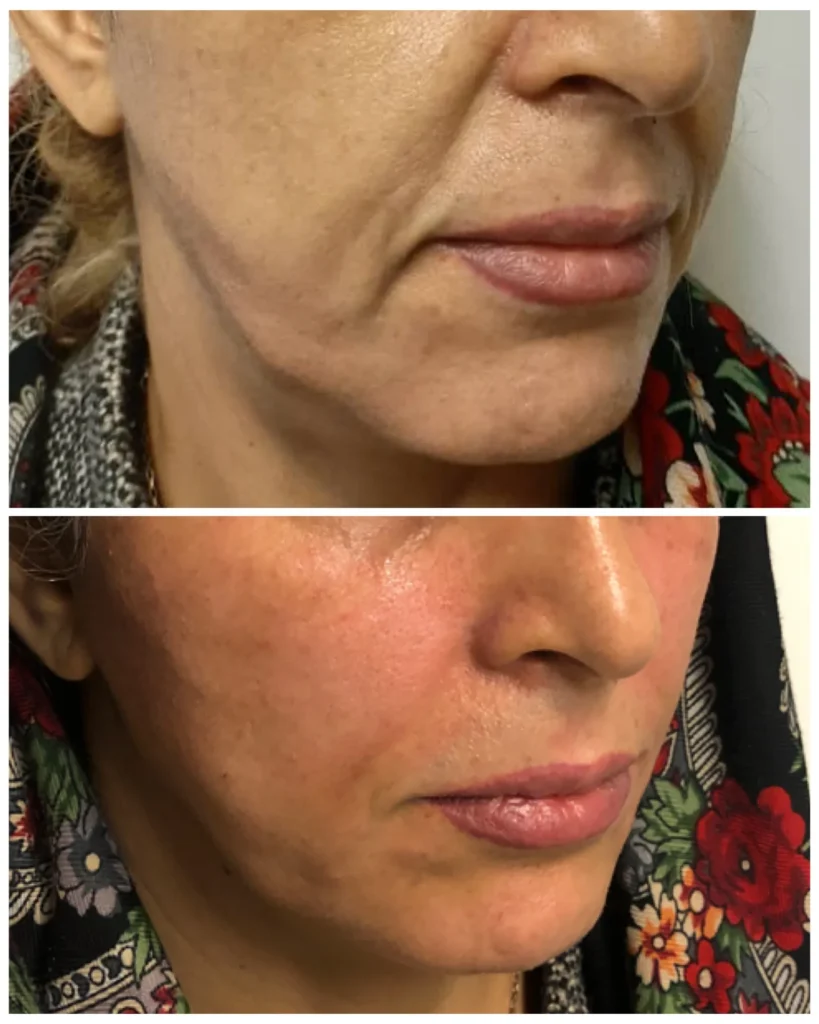
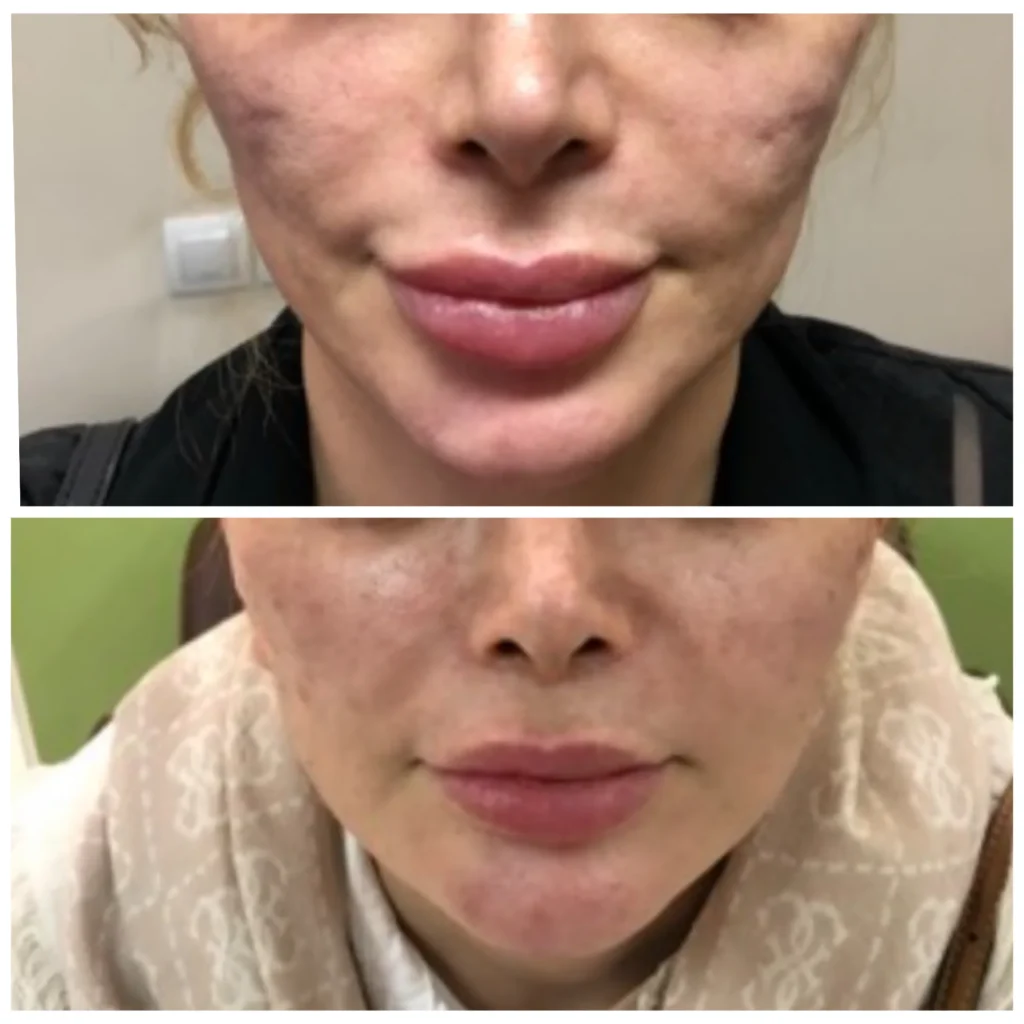
Before and After
Collagen-stimulating injectable — volume restored gradually — treated by Dr. Azra Vaziri, Dubai.
Biostimulator — lost facial volume gradually restored — treated by Dr. Azra Vaziri, Dubai.
Photographs published with the patients’ written consent, in line with UAE medical advertising regulations. Individual results vary.
⎯ Ideal Candidates
Who Is AestheFill Best For?
The 'Natural Results' Patient
Because AestheFill stimulates your own collagen gradually over multiple sessions, the results look and feel authentically natural — no sudden changes, no “done” appearance. Perfect for patients who want rejuvenation that nobody can pinpoint.
Long-Term Thinkers
Patients who understand that the best aesthetic results come from building your skin’s own infrastructure over time, rather than repeated quick fixes. AestheFill rewards patience with results that last up to 2 years and improve with each maintenance cycle.
Mid-Face & Temple Volume Loss
AestheFill excels at restoring volume in the cheeks, temples, and mid-face — areas where age-related volume loss creates a hollow, tired appearance. Also excellent for patients experiencing Ozempic face volume loss.
Deep Folds & Wrinkle Correction
Particularly effective for smoothing nasolabial folds and marionette lines with long-lasting collagen support rather than temporary filler volume.
Skin Quality & Elasticity
Beyond volume, AestheFill improves overall skin quality — stimulating collagen, elastin, and hyaluronic acid production for firmer, more elastic, healthier-looking skin. Ideal for addressing collagen loss and early aging.
⎯ Treatment Areas
AestheFill Treatment Areas
Not suitable for: Lips (use lip filler instead), directly under the eyes (use under-eye filler), pregnancy/breastfeeding, active infections or inflammation, keloid-prone skin, or patients with known hypersensitivity to any product component. AestheFill cannot be dissolved — expert injector selection is essential.
- Cheeks — restores mid-face volume for a lifted, youthful contour
- Temples — fills temple hollowing that creates an aged, sunken appearance
- Jawline — defines and sharpens the jaw for improved facial structure
- Nasolabial folds — smooths deep smile lines with collagen support
- Marionette lines — reduces downturned mouth lines
- Chin — non-surgical chin augmentation and profile improvement
- Forehead — smooths forehead lines and restores frontal convexity
⎯ Preparation & Aftercare
Pre & Post-Treatment Care
Before Treatment
Avoid blood-thinning medications and supplements (aspirin, ibuprofen, fish oil, vitamin E, ginseng, ginkgo) for 1 week. Arrive with clean skin. Inform Dr Azra of all medications, allergies, and previous aesthetic treatments.
After Treatment
Massage treated areas as instructed by Dr Azra. No makeup for 6 hours. Avoid intense exercise, sauna, extreme heat or cold, and prolonged sun for 48 hours. No facial massage or other treatments for 2 weeks. Apply SPF 30+ daily.
Results Timeline
Some initial volume visible immediately. Collagen stimulation builds progressively over 1–3 months across 2–3 sessions. Full results visible by month 2–3. Effects last 18–24 months. Annual maintenance recommended.
⎯ Compare Your Options
AestheFill vs Sculptra vs Radiesse vs HA Fillers
| Feature | AestheFill (PDLLA) | Sculptra (PLLA) | Radiesse (CaHA) | HA Fillers |
|---|---|---|---|---|
| Primary action | Progressive biostimulation | Progressive biostimulation | Volume + biostimulation | Immediate volume |
| Particle type | Porous microspheres | Solid microparticles | Smooth CaHA microspheres | Cross-linked gel |
| Immediate result? | Partial — gradual build | No — gradual only | Yes — instant lift | Yes — instant volume |
| Sessions | 2–3 (4–6 weeks apart) | 2–3 (4–6 weeks apart) | 1 (touch-up at 2 weeks) | 1 (touch-up at 2 weeks) |
| Results last | 18–24 months | Up to 24 months | 12–18 months | 6–18 months |
| Reconstitution | Quick — minutes | 24–72 hours advance | Ready to use | Ready to use |
| Dissolvable? | No — biodegrades naturally | No — biodegrades naturally | No — biodegrades naturally | Yes — hyaluronidase |
AestheFill vs Sculptra
Both are polylactic acid biostimulators requiring 2–3 sessions. AestheFill uses PDLLA with porous microspheres; Sculptra uses PLLA with solid microparticles.
DetailsShow less
AestheFill’s porosity provides earlier volume retention and allows 3D collagen growth inside the particles. AestheFill also reconstitutes in minutes rather than hours. Both deliver excellent long-term results lasting up to 24 months. The choice often depends on practitioner preference and patient-specific factors.
AestheFill vs Radiesse
Radiesse provides immediate volume from its gel carrier plus collagen stimulation from CaHA microspheres — a dual-action approach in a single session.
DetailsShow less
AestheFill is purely a progressive biostimulator with no immediate volumising effect. Radiesse suits patients wanting instant correction; AestheFill suits patients preferring gradual, purely natural-looking change. Dr Azra offers both and can recommend the best option based on your goals.
AestheFill vs HA Fillers
HA dermal fillers provide instant volume and are dissolvable — ideal for lips and under-eyes.
Read moreShow less
AestheFill provides progressive collagen stimulation with much longer-lasting results (18–24 months vs 6–12). AestheFill cannot be dissolved, so expert technique is essential. For patients tired of frequent HA filler top-ups, AestheFill offers a longer-term collagen-building alternative.
Dr Azra often combines biostimulators strategically. For example, AestheFill for progressive collagen building paired with Radiesse for immediate jawline definition. Or AestheFill combined with Profhilo for structure plus glow. RF microneedling can also be layered for enhanced skin tightening.
Who Injects Your AestheFill — Dr Azra Vaziri
PDLLA is placed and then left to work for months, so the judgement that matters is how much to put in and where to stop.
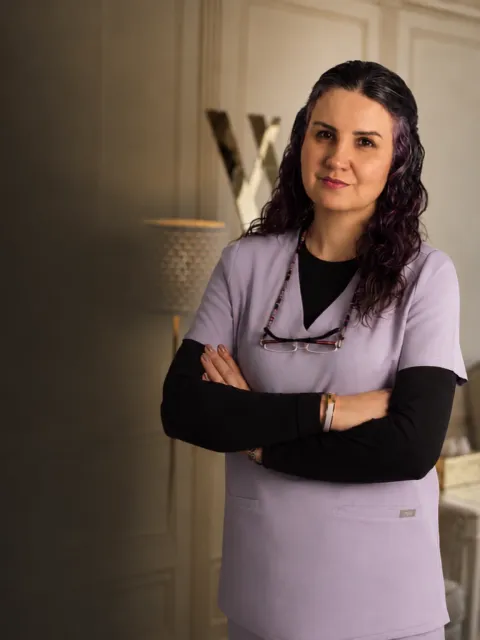
Every AestheFill appointment at this clinic is assessed and injected by Dr Azra Vaziri herself — a DHA- and DOH-licensed aesthetic physician with more than 20 years of experience, practising aesthetic medicine since 2004.
Training with collagen biostimulators
- Silhouette Soft and Ellansé workshops — Sinclair distributor in Iran (2014–2022) — Ellansé is a collagen biostimulator of the same class, and she ran the injection training for it.
- Clinical trainer for Merz Aesthetics (2015–2023) — Merz makes Radiesse, one of the three treatments this page compares AestheFill with.
- Speaker — IMCAS World Congress 2024 (Paris), and Dubai Derma in 2023 and 2026
⎯ Investment
AestheFill Price in Dubai — Cost Per Vial
AestheFill costs AED 2,200 to AED 5,000 per session in Dubai (standard AED 2,500 per vial), depending on the treatment area, number of vials, and total sessions required. Each vial contains 200mg of PDLLA. Facial treatments typically require 1–2 vials per session across 2–3 sessions spaced 4–6 weeks apart.
Maintenance: Annually
Book a consultation for a personalised quote →
AestheFill’s 18–24 month longevity makes it highly cost-effective compared to shorter-lasting alternatives. Visit our biostimulator pricing page or book a consultation for a personalised quote.
- Per Vial (200mg PDLLA)
- From AED 2,200
standard AED 2,500 - Facial Volume (1–2 vials/session)
- 2–3 sessions, 4–6 weeks apart
- Results Duration
- 18–24 months
⎯ Why Choose AestheFill
Key Benefits
- Porous microsphere technology — 3D collagen scaffold with more surface area than solid particles for enhanced stimulation
- 18–24 month results — among the longest-lasting biostimulators, reducing treatment frequency
- Triple stimulation — stimulates collagen, elastin, and hyaluronic acid for comprehensive skin rejuvenation
- Quick reconstitution — ready in minutes, unlike PLLA which may require hours of advance preparation
- Lower complication rate — clinical evidence shows fewer complications compared to PLLA-based fillers
- Naturally progressive — gradual results that look authentically natural, never “overdone”
- Fully biodegradable — breaks down into water and CO₂. No permanent material left in the body
AestheFill FAQ — Frequently Asked Questions
What is AestheFill?
AestheFill is a next-generation injectable biostimulator composed of poly-D,L-lactic acid (PDLLA) porous microspheres, manufactured by REGEN Biotech in South Korea. It stimulates your body’s own collagen production for progressive, natural-looking facial rejuvenation lasting 18 to 24 months. PDLLA is FDA-substance approved and has been used in medical applications for over 30 years.
How is AestheFill different from Sculptra?
Both are polylactic acid biostimulators, but AestheFill uses PDLLA with porous microspheres while Sculptra uses PLLA with solid microparticles. AestheFill’s porosity allows 3D collagen growth inside the particles, provides earlier volume retention, reconstitutes in minutes rather than hours, and clinical studies show a lower complication rate. Both deliver results lasting up to 24 months.
What areas can AestheFill treat?
Cheeks, temples, jawline, nasolabial folds, marionette lines, chin, and forehead. Not suitable for lips or directly under the eyes — HA fillers are recommended for those areas.
How long does AestheFill last?
18 to 24 months. The PDLLA microspheres are naturally biodegraded into water and CO₂ over 3–6 months, but the collagen your body has produced remains long after the product is absorbed.
How many sessions do I need?
Most patients require 2 to 3 sessions spaced 4 to 6 weeks apart. Results build progressively with each session. Annual maintenance is recommended.
Is AestheFill safe?
PDLLA is FDA-substance approved and has been used in medical applications for over 30 years. AestheFill was first approved by the Korean FDA in 2014. It is biocompatible, fully biodegradable, and non-allergenic. Clinical studies confirm a lower complication rate compared to PLLA-based fillers. No allergy testing required.
Does AestheFill hurt?
Topical numbing cream is applied before treatment. Lidocaine can be mixed into the reconstituted solution for added comfort. Most patients describe mild pressure or brief stinging. Dr Azra uses cannula technique where appropriate for maximum comfort.
Can AestheFill be dissolved?
No. Like Sculptra and Radiesse, AestheFill cannot be dissolved with hyaluronidase. It is fully biodegradable and is naturally broken down by the body into water and CO₂ over 3–6 months. Proper injection technique and post-treatment massage minimise the risk of nodule formation.
What is the price of AestheFill in Dubai?
Pricing starts from AED 2,200 per vial (standard AED 2,500). Total cost depends on treatment area, number of vials, and sessions required. Visit our biostimulator pricing page for details.
Can AestheFill be combined with other treatments?
Yes. Combines well with Botox, HA fillers for lips/under-eyes, Profhilo for skin hydration, Radiesse for immediate structure, and RF microneedling for enhanced skin tightening.
What makes AestheFill's porous microspheres unique?
AestheFill’s PDLLA microspheres have a sponge-like porous structure with multiple micropores. Fibroblasts grow both on the surface and inside each microsphere, creating a 3D collagen scaffold. This differs from Sculptra’s solid particles where collagen only forms on the outside. The result is more uniform collagen distribution and earlier volume retention.
How does AestheFill fit into a regenerative treatment plan?
AestheFill is part of Dr Azra’s regenerative aesthetics approach. It provides the collagen foundation, while skin boosters address hydration, polynucleotide therapy enhances cellular repair, and thread lifting provides tissue repositioning. Patients seeking a non-surgical facelift often benefit from AestheFill as the collagen-building anchor of their treatment plan.
⎯ Explore More
Complementary Treatments
⎯ Related Concerns
Concerns AestheFill Can Address
Collagen LossSaggy SkinOzempic FaceEarly Aging
Browse all treatments under All Treatments, Skin Treatments, and Biostimulators.
Book A Consultation With Dr Azra
Patients seeking personalized aesthetic assessment in Dubai can contact Dr Azra for consultation regarding AestheFill, biostimulators, and regenerative skin treatment planning.
Dr Azra Vaziri is a DHA and DOH licensed aesthetic physician practicing in Dubai, with over 20 years of experience in aesthetic medicine, injectables, thread lifting, and non-surgical facial rejuvenation.
Book a Consultation
Dr Azra Vaziri — DHA & DOH licensed aesthetic physician with 20+ years of experience in Dubai & Abu Dhabi.