Hyperpigmentation Treatment in Dubai
Hyperpigmentation treatment depends on the type: melasma responds to gentle peels and tranexamic acid, sun spots improve with Dermapen microneedling, and post-inflammatory pigmentation from acne needs a combination approach. Treatment typically involves 4–8 sessions spaced 2–4 weeks apart. Daily SPF 50 is essential throughout.
- 4–8Sessions
- 2–4 wksBetween sessions
- 30–45 minPer session
- SPF 50Daily, essential
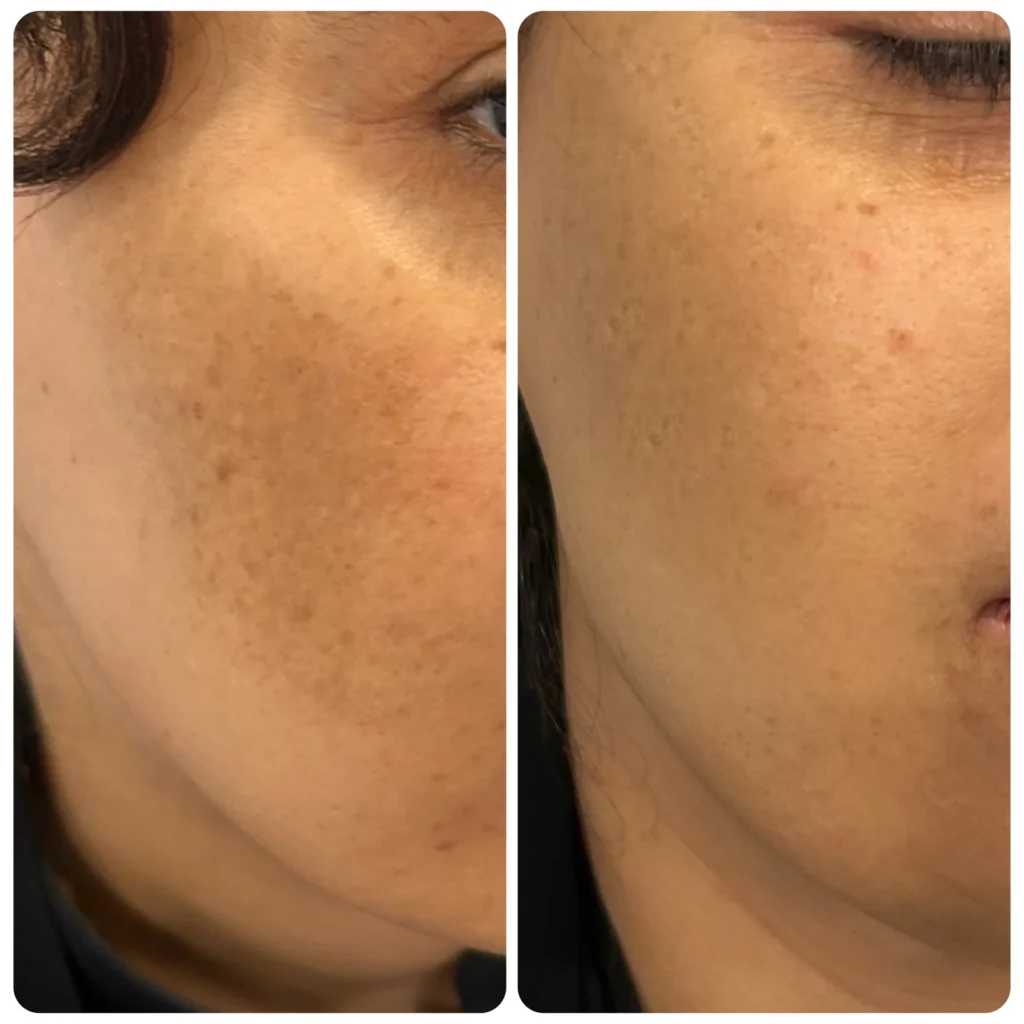
* Photograph published with the patient’s written consent, in line with UAE medical advertising regulations. Individual results vary — book a consultation to see cases similar to yours. Pigmentation booster, before and after — Dr Azra Vaziri, Dubai.
In Simple Terms
Melasma, sun spots and post-inflammatory pigmentation each need a different approach. Dr Azra Vaziri identifies your pigmentation type first, then treats with Dermapen, chemical peels, mesotherapy and targeted skincare — chosen for your skin type and tone.
Dark spots, visibly faded. A course of targeted pigmentation treatment breaks up excess melanin and evens the skin tone — without harsh peeling or downtime. Because the wrong protocol can make pigmentation worse, especially in medium-to-deeper skin tones, the diagnosis comes before the treatment.
Types of Hyperpigmentation
Not all dark patches are the same, and the treatment that clears one type can worsen another. Identifying which of the three you have is the first step.
Melasma
Hormonal pigmentation — symmetrical brown patches on cheeks, forehead or upper lip. Triggered by sun, pregnancy, hormones or heat. Chronic: it can be managed but tends to recur, so it needs gentle, consistent treatment rather than aggressive clearing.
Sun Spots
Also called solar lentigines or age spots. Flat brown spots from cumulative UV exposure, common on the face, hands and décolletage. Responds well to Dermapen and targeted peels. Patients noticing broader early aging signs often benefit from combined treatment.
Post-Inflammatory (PIH)
Dark marks left behind after acne, injury or inflammation. More common in darker skin tones. PIH can fade on its own over many months, but clinical treatment accelerates it considerably. See also acne scar treatment.
Unsure which of the three you are dealing with? Book a consultation with Dr Azra.
Treatment Options for Pigmentation
Dermapen microneedling
Microneedling with targeted serums (vitamin C, tranexamic acid, niacinamide) is one of the most effective and safest options across all skin types.
Read moreShow less
Unlike laser it carries a lower risk of post-inflammatory hyperpigmentation in deeper skin tones. PRP can be added to boost collagen stimulation and healing.
Chemical peels
Peels using lactic acid, mandelic acid or a modified Jessner formula exfoliate pigmented cells from the surface.
Read moreShow less
Dr Azra selects the peel type and strength from your skin type and the depth of the pigment. See microneedling vs chemical peels.
Boosters and polynucleotides
Skin boosters and polynucleotides rebuild the dermal hydration and skin quality that underpin an even complexion.
Read moreShow less
Where dullness sits alongside pigmentation, exosome therapy and Profhilo restore overall radiance. More on how regenerative treatments work.
Skincare and sun protection
Skincare is not the optional part
DetailsShow less
— it does most of the long-term work. Vitamin C, niacinamide, arbutin, tranexamic acid and retinoids are the evidence-based ingredients. Daily SPF 50 is non-negotiable: without it, clinical results are reversed by sun exposure.
Want a protocol matched to your pigment type and skin tone? Book a consultation with Dr Azra.
Treatment at a Glance
| Detail | What to Know |
|---|---|
| Treatment time | 30–45 minutes |
| Downtime | Little to none (peels and facials); brief redness (needling) |
| Results visible | Surface spots in weeks; deeper pigment over months |
| Course | A series of sessions plus home care |
| Essential | Daily broad-spectrum SPF |
| Maintenance | Periodic, to keep the tone even |
Treatments by Pigment Type
| Treatment | Best for | Onset and notes |
|---|---|---|
| Chemical peel | Sun spots, dullness, surface PIH | Days to weeks. Strength matched to skin type |
| Mesotherapy / brightening | Overall tone and melanin control | Weeks. Antioxidant and pigment-regulating |
| Microneedling | PIH and uneven texture | Weeks. Boosts absorption of actives |
| Home care + SPF | Prevention and maintenance | Ongoing. Does much of the long-term work |
Results Timeline
| When | What happens |
|---|---|
| Days 1–3 | Mild flaking or redness after peels or needling; surface renewal begins |
| Weeks 2–4 | Surface sun spots and post-acne marks start to fade |
| Months 2–3 | Tone looks clearer and more even with continued sessions |
| Deeper pigment | Treated gradually over a longer period to avoid irritation |
| Ongoing | Home care and SPF maintain the result and prevent new spots |
Important Considerations & Safety
Pigmentation is the one skin concern where the wrong treatment reliably makes things worse. These points matter more than the choice of device.
Daily SPF 50 is non-negotiable
Sun protection is not aftercare advice, it is part of the treatment.
Read moreShow less
Without daily broad-spectrum SPF 50, reapplied through the day, clinical results are undone by Dubai’s year-round UV and new pigment forms. Patients who will not commit to sun protection should not start a pigmentation course.
Aggressive treatment can worsen pigmentation
In medium-to-deeper skin tones (Fitzpatrick IV–VI), overly strong peels, heat and aggressive laser can trigger rebound post-inflammatory hyperpigmentation
Read moreShow less
— darker skin than you started with. Dr Azra deliberately selects gentler protocols and builds up slowly rather than chasing a fast result.
Prescription actives need supervision
Hydroquinone, tranexamic acid and prescription retinoids are effective but are not indefinite-use products.
Read moreShow less
They need a doctor to set the strength, the cycle length and the stopping point, and to monitor for irritation or rebound. Over-the-counter “whitening” creams of unknown composition are a common cause of worsened pigmentation.
Pregnancy and breastfeeding
Melasma is frequently triggered by pregnancy and often settles on its own afterwards, so active treatment is usually deferred.
DetailsShow less
Several standard pigmentation actives are not suitable while pregnant or breastfeeding. See the pregnancy and breastfeeding safety guide and tell Dr Azra at consultation.
What is normal after treatment
Temporary redness, mild warmth and light flaking are expected after peels and needling and settle within a few days.
Read moreShow less
Pigment often looks slightly darker before it lifts — that is the treated melanin moving to the surface, not a failure.
When to call the clinic
Contact us if you have blistering, spreading redness, unusual pain, signs of infection, or if a treated area is getting steadily darker rather than lighter.
DetailsShow less
Do not apply further actives or attempt to treat it yourself — message the clinic and we will review it.
Have a question about safety before you book? Book a consultation with Dr Azra.
Who Is a Good Candidate?
Well suited
Adults with a clearly identified pigment type — sun spots, PIH or stable melasma — who are willing to use daily sun protection and follow a home routine between sessions. Patients of any skin tone are treatable; the protocol changes, not the eligibility.
Treat with caution
Active melasma flaring under hormonal change, very recent sun exposure or tanning, active acne or eczema in the treatment area, and recent isotretinoin use. These do not rule you out, but they change the timing and the strength used.
Not the right time
Pregnancy and breastfeeding for most active protocols, active skin infection or cold sore in the area, broken or irritated skin, and unrealistic expectations of a single-session cure. Pigmentation improves in courses, not in one visit.
Not sure whether now is the right time to start? Book a consultation with Dr Azra.
Before Your Treatment and Aftercare
Before your treatment
- ✓Use daily sun protection in the run-up to treatment
- ✓Pause retinoids and strong acids a few days before peels or needling
- ✓Avoid recent sun exposure, tanning or waxing on the area
- ✓Reschedule if the skin is irritated, or you have an active breakout or cold sore
- ✓Bring any prescription brightening creams you are already using
Aftercare
Need the aftercare checked for your own routine? Book a consultation with Dr Azra.
- ✓Apply and reapply broad-spectrum SPF daily — without it, pigment returns
- ✓Avoid make-up for 12–24 hours after microneedling
- ✓Skip heat, sweat and active skincare for 3–5 days
- ✓Expect mild flaking or redness; do not pick or scrub the skin
DetailsShow less
- ✓Resume your brightening routine only when Dr Azra confirms the skin is settled
Combining Treatments for Even Tone
Pigmentation responds best to a combined approach matched to its type. Dr Azra often pairs chemical peels to lift surface pigment with mesotherapy or brightening protocols to reduce melanin production, and microneedling to improve texture and help the actives penetrate. A consistent home routine plus daily SPF underpins all of it.
Where post-acne marks are the cause, controlling the active breakouts at the same time prevents new pigmentation from forming — treating the marks while the acne continues simply replaces them. Where pigmentation sits alongside laxity or volume loss, the pigment work is usually done first, so the skin is calm before anything more stimulating is added.
Want the two combined into one plan? Book a consultation with Dr Azra.
Who Reads Your Pigment First — Dr Azra Vaziri
Pigment that sits in the surface layer and pigment that sits deeper need opposite treatments, and treating the wrong one darkens the skin instead.
Every Hyperpigmentation Treatment appointment at this clinic is assessed and injected by Dr Azra Vaziri herself — a DHA- and DOH-licensed aesthetic physician with more than 20 years of experience, practising aesthetic medicine since 2004.
Training behind the reading
- Certified American Academy of Aesthetic Medicine (2012) — with more than twenty years of clinical practice on the skin types most prone to post-inflammatory pigment.
- Mesotherapy workshops — Mesoestetic Pharma Group distributor in Iran (2018–2023) — the injectable side of pigment management, taught to other physicians.
- Speaker — IMCAS World Congress 2024 (Paris), and Dubai Derma in 2023 and 2026
Why Patients Choose Dr Azra
Because pigmentation has several causes that each need a different strategy, the most important step is an accurate diagnosis — and that is where doctor-led care matters. Dr Azra Vaziri identifies exactly which type of pigmentation you have before recommending treatment, avoiding the common mistake of treating everything the same way.
With over 20 years of experience and particular care for medium-to-deeper skin tones, she selects peel strengths and protocols that fade pigment without triggering more, and builds in the home care and sun protection that prevent recurrence. As a DHA and DOH-licensed physician, she balances visible results with the long-term health of your skin.
Ready to have your pigmentation type diagnosed? Book a consultation with Dr Azra.
Visiting Dr Azra’s Clinic in Dubai
Sun-driven pigmentation is one of the most common skin concerns in Dubai’s high-UV climate. Dr Azra Vaziri treats patients from across Dubai — Downtown, Business Bay, Jumeirah, Dubai Marina and JBR — at her clinic on Sheikh Zayed Road (Exit 41), beginning every plan by diagnosing your specific type of pigmentation. Dr Azra Vaziri sees patients at two clinics: Prof Sakla Spanish Eye Clinic on Sheikh Zayed Road, Dubai, and — on Wednesdays — Louvre Medical Clinic in Abu Dhabi. Choose whichever is closer to you. Book a consultation by phone or WhatsApp.
Frequently Asked Questions
What is the best treatment for hyperpigmentation in Dubai?
How many sessions are needed?
Most pigmentation protocols involve 4–8 sessions spaced 2–4 weeks apart. Improvement is gradual. Maintenance sessions and daily SPF 50 are essential to prevent recurrence.
Is laser safe for dark skin pigmentation?
Laser carries higher risk for darker skin types due to potential post-inflammatory hyperpigmentation. Dr Azra prefers Dermapen, chemical peels and topical treatments for darker skin — these carry lower risk of worsening pigmentation. RF microneedling is another safe option for texture improvement in darker skin tones.
Can hyperpigmentation be fully removed?
Sun spots and PIH can often be significantly faded or resolved. Melasma is chronic — it can be managed and improved but may recur with sun exposure or hormonal changes. Consistent treatment and daily SPF are essential.
What skincare helps with hyperpigmentation?
Vitamin C, niacinamide, arbutin, tranexamic acid and retinoids are evidence-based ingredients. Daily SPF 50 is non-negotiable. Dr Azra recommends a personalised skincare protocol alongside clinical treatments.
Can pigmentation treatments be combined with other procedures?
Yes. Pigmentation treatment pairs well with skin boosters for hydration, Profhilo for bio-remodelling, and PRP for growth factor–driven renewal. Patients with skin laxity alongside pigmentation may benefit from thread lifting or biostimulators as part of a comprehensive regenerative protocol.
How much does pigmentation treatment cost in Dubai?
Pricing depends on the treatments selected and the number of sessions in your protocol. Dermapen pricing and skin booster pricing are available on our pricing pages. Dr Azra provides a personalised quote during consultation.
Does Dermapen work for pigmentation?
Yes. Dermapen microneedling is one of the safest and most effective treatments for pigmentation across all skin types. It creates micro-channels that allow brightening serums to penetrate deeper while stimulating the skin’s natural renewal process. See our Dermapen before and after results. For patients also concerned about dull skin or uneven texture, Dermapen addresses multiple concerns simultaneously.
What causes pigmentation to worsen in Dubai?
Dubai’s intense UV radiation is the primary trigger. Heat, humidity, and hormonal factors also contribute. Even brief unprotected sun exposure can reactivate melasma or darken existing spots. Daily SPF 50, reapplied throughout the day, is essential during and after treatment. Patients with broader aging concerns often find that addressing pigmentation improves their overall appearance significantly.
Where to go next
Read next: View pricing.
Book a Consultation
Dr Azra Vaziri — DHA & DOH licensed aesthetic physician with 20+ years of experience in Dubai & Abu Dhabi.