Go straight to
Acne Scar Treatment in Dubai
Acne scars treatment in Dubai starts with identifying your scar type. Acne scars are among the most persistent and emotionally frustrating skin concerns. Long after the breakouts have cleared, the scars they leave behind — pitted, raised, discoloured, or uneven — can affect how you feel about your skin every time you look in the mirror.
Over-the-counter products and home remedies rarely make a meaningful difference, because acne scars involve structural damage beneath the skin’s surface that topical care simply cannot reach.
Acne Scar Treatment in Dubai at a glance
Dr Azra matches acne scar treatment in Dubai to your scar type — Dermapen, RF microneedling and peels for ice pick, boxcar and rolling scars.
Performed by Dr Azra Vaziri at Prof Sakla Spanish Eye Clinic, Dubai
Types of Acne Scars
Not all acne scars are the same. Identifying the type of scarring you have is essential, because different scar types respond to different treatments. For a deeper explanation of each type and how it is treated, see our acne scar types and treatments guide.
Ice Pick Scars
Deep, narrow, V-shaped pits that extend into the dermis. They look like the skin has been punctured with a sharp instrument. The most difficult type to treat because of their depth relative to their narrow opening. Ice pick scar treatment →
Boxcar Scars
Round or oval depressions with steep, well-defined edges. They create a pitted, crater-like appearance and are most common on the cheeks and temples. Width varies from shallow to deep. Boxcar scar treatment →
Rolling Scars
Broad, shallow depressions with sloping, undulating edges that create a wave-like unevenness across the skin. They result from fibrous bands tethering the skin to deeper tissue and respond well to treatments that break these bands and stimulate collagen. Rolling scar treatment →
Hypertrophic / Keloid Scars
Raised, thickened tissue that forms when the body produces excess collagen during healing. More common on the chest, back, and jawline. Keloid scars extend beyond the original wound boundary.
Post-Inflammatory Hyperpigmentation
Dark marks left behind after a blemish heals — not true scars, but flat discolourations that can persist for months or years. Particularly common in patients with higher Fitzpatrick skin types and in the UAE’s high-UV environment. See our dedicated hyperpigmentation treatment page for targeted protocols.
Post-Inflammatory Erythema
Red or pink marks that remain after a breakout, caused by residual inflammation and dilated blood vessels. More visible on lighter skin tones and can take months to resolve without treatment.
Acne Scar Treatments Available
Effective acne scar treatment almost always requires a combination approach — no single treatment addresses all scar types equally. Dr Azra Vaziri assesses your specific scar pattern and selects from the following based on the types, depths, and locations of scarring present. Browse our full range of skin treatments and face treatments to see how acne scar protocols fit within a broader skin quality plan.
RF Microneedling (Potenza)
RF microneedling delivers radiofrequency energy through insulated needles into the scar tissue, triggering deep collagen remodelling and tissue restructuring. The combination of mechanical micro-injury and targeted heat makes it one of the most effective treatments for moderate to severe atrophic acne scars, particularly boxcar and rolling types. For a comparison with other energy-based devices, see our Morpheus8 vs HIFU guide.
Dermapen Microneedling
Dermapen microneedling creates controlled micro-channels that trigger the wound-healing cascade, stimulating new collagen and elastin production. It is effective for mild to moderate acne scars and can be combined with PRP (see also: vampire facial) or exosomes for enhanced results. Safe for all Fitzpatrick skin types. See real patient outcomes on our Dermapen before and after page, and explore our best Dermapen serums guide for optimising your post-treatment recovery.
Pricing: View Dermapen pricing
Fractional Laser Resurfacing
Fractional laser creates thousands of microscopic treatment zones in the skin, triggering intensive collagen remodelling while leaving surrounding tissue intact for faster healing. Both ablative and non-ablative options are available depending on scar severity. Laser resurfacing requires careful parameter selection for higher Fitzpatrick types to minimise pigmentation risk.
Chemical Peels
Medical-grade chemical peels use controlled acid solutions (TCA, glycolic, salicylic, or combination formulations) to remove damaged surface layers of skin and stimulate renewal from beneath. They are particularly effective for shallow scarring, post-inflammatory hyperpigmentation, and overall texture improvement. Deeper peels (TCA CROSS) can be used to treat individual ice pick scars. Wondering how peels compare with microneedling for resurfacing? Read our microneedling vs chemical peels comparison.
| Best for | Sessions | |
|---|---|---|
| RF Microneedling (Potenza) | Boxcar scars, rolling scars, deep texture irregularity, moderate to severe scarring | 3–4 sessions spaced 4–6 weeks apart |
| Dermapen Microneedling | Mild to moderate scarring, rolling scars, shallow boxcar scars, overall texture | 4–6 sessions spaced 4–6 weeks apart |
| Fractional Laser Resurfacing | Moderate to severe scarring, ice pick scars (ablative), overall resurfacing, pigmentation | 3–5 sessions depending on type and intensity |
| Chemical Peels | Shallow scars, hyperpigmentation, PIH, texture refinement, targeted ice pick treatment | 3–6 sessions spaced 2–4 weeks apart (varies by peel depth) |
Skin Boosters
Skin booster injections deliver hyaluronic acid directly into the dermis to restore deep hydration, improve skin quality, and support healing between more intensive scar treatments. Particularly useful for acne-scarred skin that is also dehydrated or lacking in overall radiance.
Role in scar protocol: Hydration support, skin quality improvement, enhanced recovery between sessions
Collagen Biostimulators
Collagen biostimulator treatment encourages your body to rebuild its own collagen gradually, providing long-term structural support that helps lift depressed scars and improve overall skin density. Often incorporated into scar protocols for patients with significant collagen loss. Compare the different options in our microneedling vs exosome therapy guide.
Role in scar protocol: Long-term collagen rebuilding, structural volume restoration in atrophic scars
Comparing Acne Scar Treatments
Most patients with moderate to severe acne scarring benefit from a combination protocol — for example, RF microneedling for deep remodelling combined with chemical peels for surface refinement and pigmentation. Subcision (releasing tethered scar bands with a needle) may also be included for rolling scars. Dr Azra Vaziri designs a personalised multi-session plan targeting each scar type present on your skin.
| Factor | RF Microneedling | Microneedling | Fractional Laser | Chemical Peel |
|---|---|---|---|---|
| Mechanism | RF energy + micro-injury for deep remodelling | Controlled micro-injury stimulates collagen | Fractional light energy resurfaces and remodels | Acid solutions remove damaged layers |
| Best scar types | Boxcar, rolling, moderate–severe | Rolling, shallow boxcar, mild–moderate | All types including ice pick (ablative) | Shallow scars, PIH, texture; ice pick (TCA CROSS) |
| Fitzpatrick safety | All skin types (insulated needles) | All skin types | Caution with higher types (pigmentation risk) | Caution with higher types (varies by peel) |
| Downtime | 2–5 days redness | 1–3 days redness | 3–10 days (depends on intensity) | 1–7 days (depends on depth) |
| Combination potential | Yes — with PRP, exosomes, subcision | Yes — with PRP, exosomes, peels | Yes — with PRP, exosomes | Yes — with microneedling, laser |
What to Expect
- Scar Assessment — Dr Azra Vaziri maps your scarring in detail — identifying types, depths, locations, skin type, and any active acne that needs to be addressed before scar treatment can begin. Active breakouts must be controlled first.
- Personalised Protocol — A multi-treatment plan is designed targeting each scar type present. This may combine RF microneedling for structural scars, peels for pigmentation, and subcision for tethered scars — scheduled over several months.
- Treatment Sessions — Depending on the protocol, treatment involves 3–6+ sessions over several months. Each session typically takes 30–60 minutes. Topical or local anaesthesia is used for comfort.
- Recovery — Downtime varies by treatment: 1–3 days for microneedling and light peels; 2–5 days for RF microneedling; 3–10 days for deeper laser resurfacing. Sun protection is critical during recovery, especially in Dubai’s climate.
- Progressive Results — Acne scar treatment is a marathon, not a sprint. Visible improvement builds progressively over weeks and months as collagen remodels. Most patients see meaningful improvement after 3–4 sessions, with continued refinement over the full treatment course.
Who May Benefit
- Patients with pitted, rolling, or boxcar acne scars on the face
- Dark marks or pigmentation left behind by previous breakouts
- Uneven, rough skin texture caused by acne damage
- Those who have tried topical treatments without meaningful improvement
- Patients whose acne is now controlled and who are ready to address the scarring
Important to Know
Not sure which of these applies to your skin? Ask Dr Azra at your consultation.
- Active acne must be controlled before scar treatment can begin — treating scars on skin that is still breaking out can worsen both the acne and the scarring
- Acne scar treatment is progressive — significant improvement is realistic, but complete elimination is rarely achievable
- Higher Fitzpatrick skin types require careful treatment selection to avoid post-inflammatory pigmentation
- Sun protection is essential during treatment — UV exposure in Dubai, Abu Dhabi, and the wider UAE can trigger hyperpigmentation and undermine results
- Patients on isotretinoin must wait a period before certain scar treatments can be performed
Related Reading
Related Concern
Post-acne texture irregularities often overlap with general roughness — explore targeted protocols.
Related Concern
Acne-scarred skin often lacks radiance — complementary protocols can restore glow alongside texture.
Related Concern
Collagen remodelling treatments for scars often improve fine lines simultaneously.
Comparison Guide
Two core scar-resurfacing approaches compared side by side.
Comparison Guide
Comparing RF microneedling with HIFU for deep collagen remodelling.
Before & After
See real patient outcomes from Dermapen microneedling at our clinic.
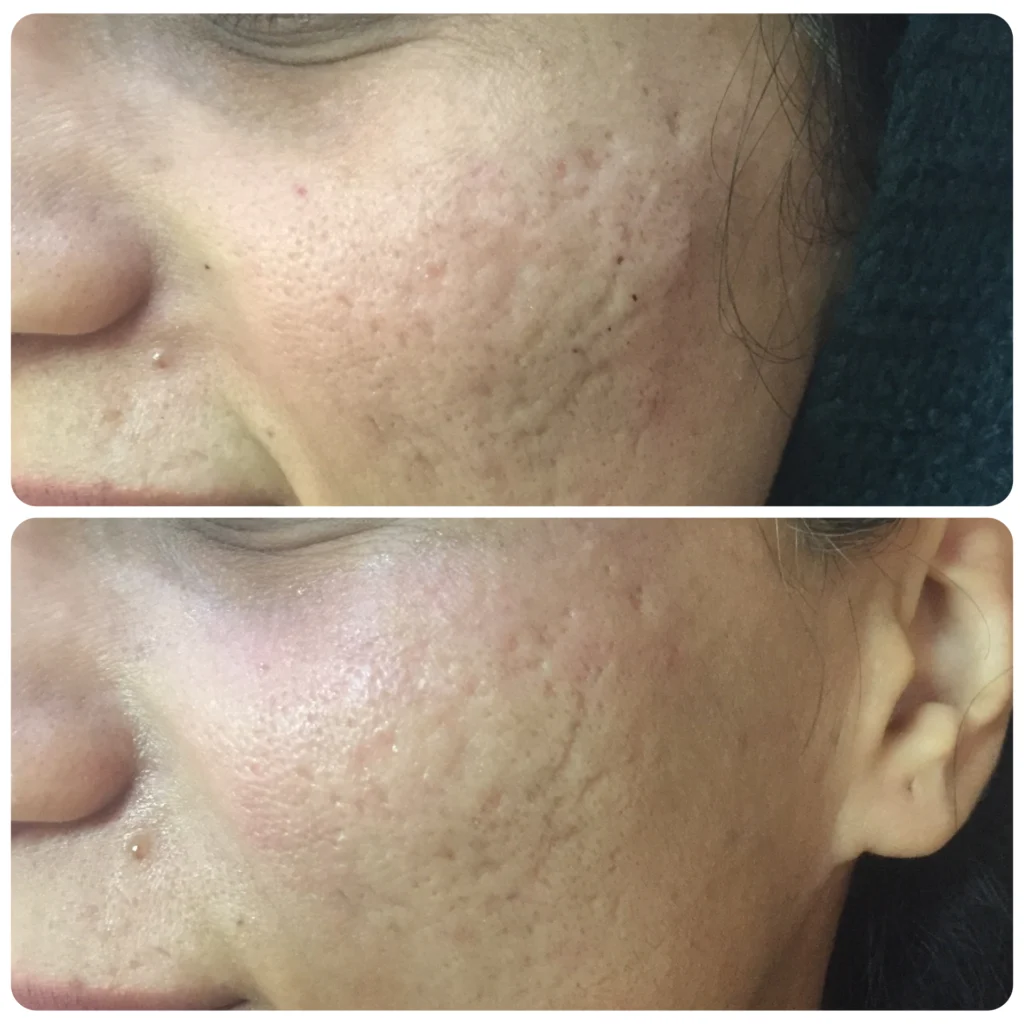
Acne Scar Treatment Before and After
Rolling acne scars, visibly smoother. After a course of Dermapen microneedling, the depressed scars across the cheek have flattened as new, organised collagen fills them from below. Texture is more even and the scarring catches far less light.
Deeper scars respond over several sessions — this is a gradual, cumulative treatment, and the improvement is permanent skin, not a filter.
Cheek acne scarring — before (top) and after (bottom). Treated by Dr. Azra Vaziri, Dubai — book an acne scar assessment.
* Photographs published with the patient’s written consent, in line with UAE medical advertising regulations. Individual results vary — book a consultation to see cases similar to yours.
Who Plans Your Scar Course — Dr Azra Vaziri
Acne scarring is rarely one scar type, so the plan matters more than any single device: which scars are tethered and need releasing, which need resurfacing, and in what order.
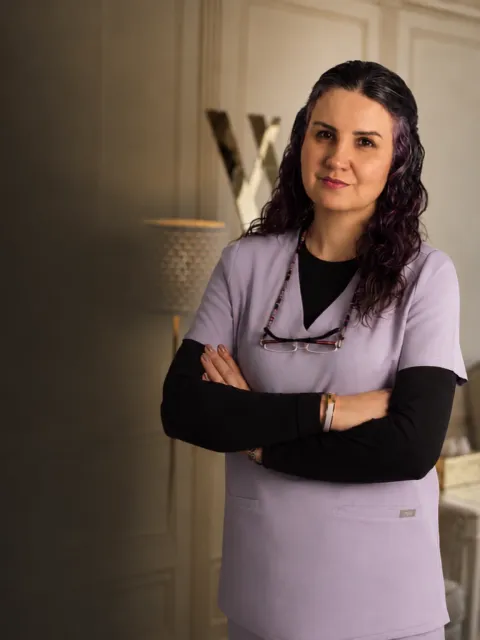
Every Acne Scar Treatment appointment at this clinic is assessed and injected by Dr Azra Vaziri herself — a DHA- and DOH-licensed aesthetic physician with more than 20 years of experience, practising aesthetic medicine since 2004.
Training behind the plan
- Think-In, Anatomy & Aesthetic Treatment Workshop (2023) — facial anatomy training, which is what subcision and deep resurfacing depend on.
- Aptos Threads International Certified Trainer
- Speaker — IMCAS World Congress 2024 (Paris), and Dubai Derma in 2023 and 2026
Frequently Asked Questions
Can acne scars be removed?
Acne scars can be significantly improved but rarely completely eliminated. Modern treatments such as RF microneedling, fractional laser, and chemical peels stimulate collagen remodelling that gradually smooths and refines the scarred skin. Most patients achieve meaningful visible improvement over a treatment course of 3 to 6 sessions.
What is the best treatment for acne scars?
There is no single best treatment because different scar types respond to different approaches. RF microneedling is highly effective for boxcar and rolling scars. Fractional laser can address deeper ice pick scars. Chemical peels work well for pigmentation and shallow scarring. The strongest results come from combining treatments tailored to your specific scar types.
How many sessions are needed for acne scar treatment?
Most protocols involve 3 to 6 sessions spaced several weeks apart, depending on the treatment selected and the severity of scarring. Improvement is progressive — you will see changes building with each session. Some patients benefit from additional sessions for deeper or more extensive scarring.
Is acne scar treatment painful?
A topical anaesthetic is applied before treatment to minimise discomfort. RF microneedling and microneedling involve mild prickling sensations. Chemical peels may cause a temporary stinging or warming feeling. Fractional laser may require stronger numbing depending on intensity. Most patients tolerate the procedures well.
What is the downtime after acne scar treatment?
Downtime varies by treatment. Microneedling involves 1 to 3 days of redness. RF microneedling involves 2 to 5 days. Chemical peels range from 1 to 7 days depending on depth. Fractional laser can require 3 to 10 days of recovery for more intensive settings. Sun protection is essential during healing.
Can acne scars be treated on dark skin?
Yes, but treatment selection must be tailored to your Fitzpatrick skin type. RF microneedling and standard microneedling are generally safe for all skin types because they bypass the epidermis. Laser and chemical peels require careful parameter selection to avoid post-inflammatory hyperpigmentation. Dr Azra Vaziri adjusts every protocol for skin type safety.
Do I need to clear my acne before treating scars?
Yes. Active acne must be controlled before scar treatment begins. Treating scars on skin that is still actively breaking out can trigger new inflammation, worsen existing scars, and create new ones. Your clinician will help manage active acne as part of your overall treatment plan.
What is subcision for acne scars?
Subcision is a technique where a needle is inserted beneath the skin to break the fibrous bands that tether rolling scars to deeper tissue. Releasing these bands allows the skin to lift and smooth out. Subcision is often combined with RF microneedling or filler for comprehensive rolling scar treatment.
Can RF microneedling help with acne scars?
Yes. RF microneedling is one of the most effective treatments for moderate to severe atrophic acne scars. The combination of micro-injury and radiofrequency energy triggers deep collagen remodelling and tissue restructuring that can significantly improve boxcar and rolling scars over a course of 3 to 4 sessions.
How long before I see results from acne scar treatment?
Some initial improvement may be visible within 2 to 4 weeks after the first session. However, collagen remodelling is a gradual process — meaningful visible improvement typically develops over 3 to 6 months with multiple sessions. Acne scar treatment requires patience and commitment to the full treatment course.
Recommended next steps
Read next: Exosomes vs PDRN vs skin boosters, BioRePeel in Dubai, Medical facials in Dubai, Back acne treatment in Dubai, Subcision for rolling acne scars in Dubai, Rolling acne scars — treatment in Dubai, Boxcar acne scars — treatment in Dubai, Ice pick acne scars — treatment in Dubai, TCA CROSS for ice pick scars and Acne scar types & treatments — full guide.
Back Acne Treatment in DubaiBoxcar Scars: What They Are and How They’re Treated in DubaiIce Pick Scars: What They Are and How They’re Treated in DubaiRolling Scars: What They Are and How They’re Treated in Dubai
Book a Consultation
Dr Azra Vaziri — DHA & DOH licensed aesthetic physician with 20+ years of experience in Dubai & Abu Dhabi.