Inside The Treatment
What Actually Happens During a Medical Facial in Dubai: A Step-by-Step Walkthrough
A medical facial runs 45–60 minutes and follows a fixed seven-stage protocol: double cleanse, magnified skin assessment, enzymatic or acid exfoliation, warm softening, extractions, a treatment mask or serum infusion, and SPF.
What separates it from an AED 150 mall facial is not the stages — it is that the protocol is written by a physician, delivered by a DHA-licensed therapist, uses prescription-strength acids, and starts with a documented assessment of your barrier, your Fitzpatrick type and your current medication. Classic Facial is AED 500 per session; the Premium HydraFacial is AED 800
In This Guide: The skin assessment · Minute-by-minute · Do extractions hurt? · What you will see · First 24–48 hours · When it is the wrong treatment
- 20+Years' experience
- DHA · DOHLicensed
- 2Clinics
- 2004Practising since
What Actually Makes a Facial “Medical” Rather Than a Spa Treatment?
The word gets used loosely across Dubai, so here is the concrete difference. Five things have to be true, and a spa facial has none of them.
A physician designs the protocol. Every facial sequence used at the clinic — which acid, at what percentage, for how many minutes, on which skin type — is written and periodically revised by an aesthetic physician, not chosen by whoever is on shift. A licensed practitioner delivers it. Your session is performed by Maryam Siadat, DHA-licensed Beauty Therapist and Skin Specialist, with five-plus years of clinical practice and internationally recognised aesthetic training. That licence is the legal difference: a DHA-licensed therapist working under physician oversight may use products and depths a spa therapist is not permitted to touch.
The actives are prescription-strength. A retail or spa “glycolic” exfoliant typically sits at 5–10% at a pH kept deliberately high to be safe in untrained hands. Clinic protocols use glycolic and salicylic preparations several times that strength, plus mandelic acid for darker phototypes, and — where indicated — escalate to a medical chemical peel such as BioRePeel CL₃, a biostimulating TCA-based peel that a spa cannot legally perform.
Assessment comes before treatment, every time. Not a form you tick at reception — a magnified examination and a medication check, described in the next section. And there is an escalation path. If the skin in front of us needs more than a facial can deliver, we say so and move you to microneedling or a peel. A spa has no ability to do that, and no financial reason to.
Here to book rather than read? Full medical facial menu & booking →
| Element | Mall / hotel spa facial | Medical facial at the clinic |
|---|---|---|
| Who wrote the protocol | Product brand’s training manual | Aesthetic physician, reviewed per skin type |
| Who performs it | Beauty therapist, no health-authority licence | DHA-licensed skin specialist under physician oversight |
| Exfoliation strength | Low-percentage AHA, buffered pH | Clinic-strength glycolic / salicylic / mandelic |
| Assessment | Verbal, 1–2 minutes | Magnified exam, Fitzpatrick typing, medication review |
| If it is not enough | Sells you another facial | Escalates to peel, microneedling or medical management |
| Typical price | AED 150–350 | AED 500 Classic · AED 800 Premium HydraFacial |
What Happens in the Skin Assessment Before Anything Touches Your Face?
The first 8–10 minutes of a first appointment are assessment, and nothing is applied until it is done. Five things get recorded.
- Fitzpatrick phototype. Most Gulf patients fall in types III–V, which carry a materially higher risk of post-inflammatory hyperpigmentation — a dark mark left behind after any inflammation. That single data point changes acid choice (mandelic or lactic over aggressive glycolic), contact time, and how firmly extractions are performed. Getting it wrong is how a facial causes the pigmentation it was meant to improve.
- Barrier condition. Skin that stings on application, flushes easily, or feels tight 20 minutes after cleansing has an impaired barrier. Exfoliating an impaired barrier makes it worse. In that case the first session becomes a barrier-repair facial — cleanse, hydrating mask, no acid, no extractions — and the actives start at session two.
- Acne grading and lesion type. Open comedones (blackheads) and closed comedones (whiteheads) can be extracted. Inflammatory papules, pustules and nodules cannot — pressing on them ruptures the follicle wall sideways into the dermis and is a reliable way to create a scar. Grade IV nodulocystic acne is referred for medical management, not facials.
- Medication and recent-procedure check. Oral isotretinoin now or within the last six months rules out extractions and clinic-strength exfoliation. Topical retinoids should be stopped 3–5 days before. Recent sun exposure, laser, waxing or threading on the treatment area within seven days, active cold sores, and pregnancy all change or postpone the plan.
- What you actually want. Congestion and blackheads, dullness before an event, and long-term texture change are three different briefs with three different answers. If your answer is the third one, a facial is a supporting act — see the HydraFacial vs medical facial vs microneedling comparison for where each one genuinely stops.
Maryam records this on a chart that is re-read at every subsequent visit, so session four is informed by what session one did. Anything ambiguous — an unexplained pigmented lesion, suspected rosacea, acne that is not responding — is escalated to Dr Azra Vaziri, DHA- and DOH-licensed aesthetic physician, before treatment proceeds. That referral route is the entire point of having a doctor in the building.
What Are the Actual Steps of a Medical Facial, Minute by Minute?
Here is the standard Classic protocol, 45–60 minutes end to end. The Premium HydraFacial replaces stages 3 and 5 with the vortex handpiece, which combines acid delivery and vacuum extraction in one pass.
Double cleanse
15 MIN
Read moreShow less
An oil or balm cleanse first, to dissolve sunscreen, makeup and sebum — all oil-soluble, and none of them removable by a foaming wash. Then a water-based cleanse to clear the residue. Sunscreen in particular is engineered to resist water; skipping the first cleanse leaves a film that blocks everything applied afterwards.
Assessment under magnification
25 MIN
Read moreShow less
Only on clean skin can congestion actually be seen. Under a magnifying lamp, Maryam maps which areas are congested, which are dehydrated, and which are inflamed and therefore off-limits for extraction. This is where the plan is finalised — the acid, the contact time, and which zones get worked.
Enzymatic or acid exfoliation
38–12 MIN
Read moreShow less
Fruit-derived enzymes (papain, bromelain) digest the protein bonds holding dead cells together, without abrasion — the choice for sensitive or reactive skin. Otherwise a chemical exfoliant: salicylic acid, which is oil-soluble and therefore travels into the pore itself, for oily and congested skin; glycolic for dullness and rough texture; mandelic, a larger molecule that penetrates more slowly, for darker phototypes where irritation risk matters more. Contact time is timed, not estimated, and neutralised on the clock.
Warm softening
45–8 MIN
Read moreShow less
Steam or warm compresses soften the keratin plug in the pore so extraction needs less force. Skipped or shortened for rosacea, active flushing and heat-triggered redness, where warmth provokes more problems than it solves. This is also the point in the session where most people stop being nervous.
Extractions
510–15 MIN
Read moreShow less
The stage everyone asks about, covered in detail below. Manual extraction with cotton-wrapped fingertips or a sterile loop, or vacuum extraction on the HydraFacial. Fifteen minutes is a deliberate ceiling — beyond that, inflammation from the work itself starts outweighing the benefit of clearing one more pore, and heavily congested skin is better cleared across three sessions than forced through one.
Mask or serum infusion
610–15 MIN
Read moreShow less
Chosen against what was found in stage 2, not booked in advance. Clay and sulphur to calm oil flow and settle post-extraction redness; hyaluronic acid and ceramides for dehydration and barrier repair; niacinamide for redness and pore appearance; an antioxidant blend of vitamin C, vitamin E and ferulic acid for dullness and UV load. On the Premium HydraFacial this stage is an antioxidant and hyaluronic acid infusion delivered by the handpiece.
Moisturiser and SPF
73–5 MIN
Non-negotiable, and not a formality. Freshly exfoliated skin has had its stratum corneum thinned, which measurably raises UV sensitivity for several days. In Dubai that matters year-round. Broad-spectrum SPF 50 goes on before you leave, and you are told to reapply it every two hours outdoors.
Total treatment time is 46–65 minutes. Add roughly 15 minutes for a first appointment, because the assessment is longer and the chart is being created from scratch.
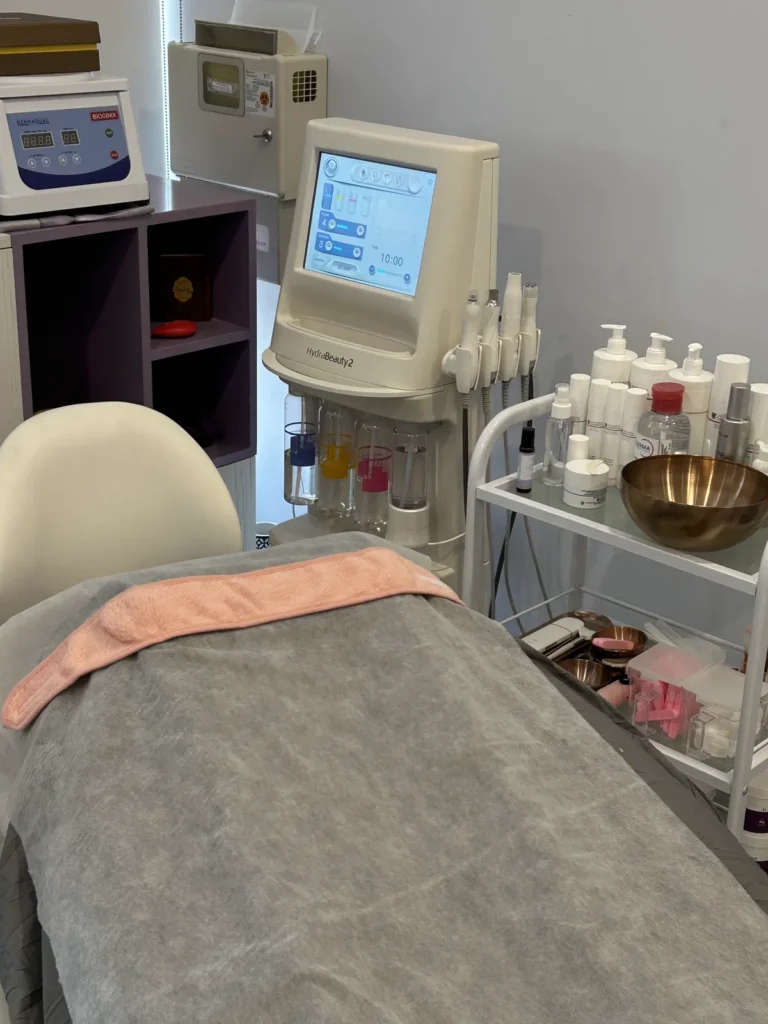
Where the steps above happen — the treatment room and HydraBeauty II device
Photographed in the treatment room at Dr Azra’s clinic.
Do Extractions Hurt, and How Is That Controlled?
Honest answer: extractions are the only uncomfortable part of a medical facial, and the discomfort is pressure rather than sharp pain. Most people rate it 2–4 out of 10. The nose and chin — where sebaceous filaments are densest and the skin is tethered to cartilage — are the sore spots. The cheeks and forehead are usually nothing.
Four things keep it controlled. Preparation does most of the work: after 8–12 minutes of correctly chosen acid and 5–8 minutes of warmth, a comedone lifts with light pressure. When an extraction hurts a lot, the usual cause is that the softening stage was rushed. Technique second: even pressure applied around the follicle, cotton-wrapped fingertips or a sterile loop rather than nails, and a firm rule of two attempts per lesion. If it does not release in two, it is left for the next session. Selection third: only comedones are extracted. Inflamed pustules and nodules are not squeezed, no matter how much you want them gone. And you can stop it: you are asked to say so, and the area is abandoned. Nothing about a facial requires you to endure it.
What is normal afterwards: pinpoint redness at extracted sites, occasionally a small amount of pinpoint bleeding on stubborn comedones, and mild tenderness on the nose. This settles within 2–6 hours in most people, and by the following morning in almost everyone.
What is not normal: bruising, broken skin, or redness still spreading at 48 hours. That is over-extraction, and in Fitzpatrick III–V it is precisely the trigger for post-inflammatory hyperpigmentation.
What Will You See Immediately, at 72 Hours, and After a Course?
Immediately (0–4 hours). Cleaner pores, a visible reduction in blackheads across the nose and chin, softer texture, and a genuine glow — largely from exfoliation and increased surface hydration, plus some transient flush. Extraction sites may still be pink for a couple of hours. This is why a facial is best booked 2–3 days before an event, not the morning of.
At 72 hours. This is when the facial actually looks its best. Redness is gone, the exfoliated surface has settled, makeup sits better, and hydration has normalised. A small minority — usually those with congested, acne-prone skin — get a brief purge around days 2–3 as deeper congestion works its way out. That is expected, and it resolves faster than the same congestion would have surfaced on its own.
Price confirmed after selecting the product and treatment plan at consultation.
Set one expectation clearly: facials do not build meaningful collagen. They work on the barrier, on congestion and on hydration — the outermost layers. Nothing in the seven stages reaches the depth at which fibroblasts remodel dermal collagen. If firmness or scar depth is the goal, that is microneedling territory, where collagen remodelling peaks around weeks 4–12 after a course of 3–4 sessions. Anyone who tells you a facial lifts the face is selling you something.
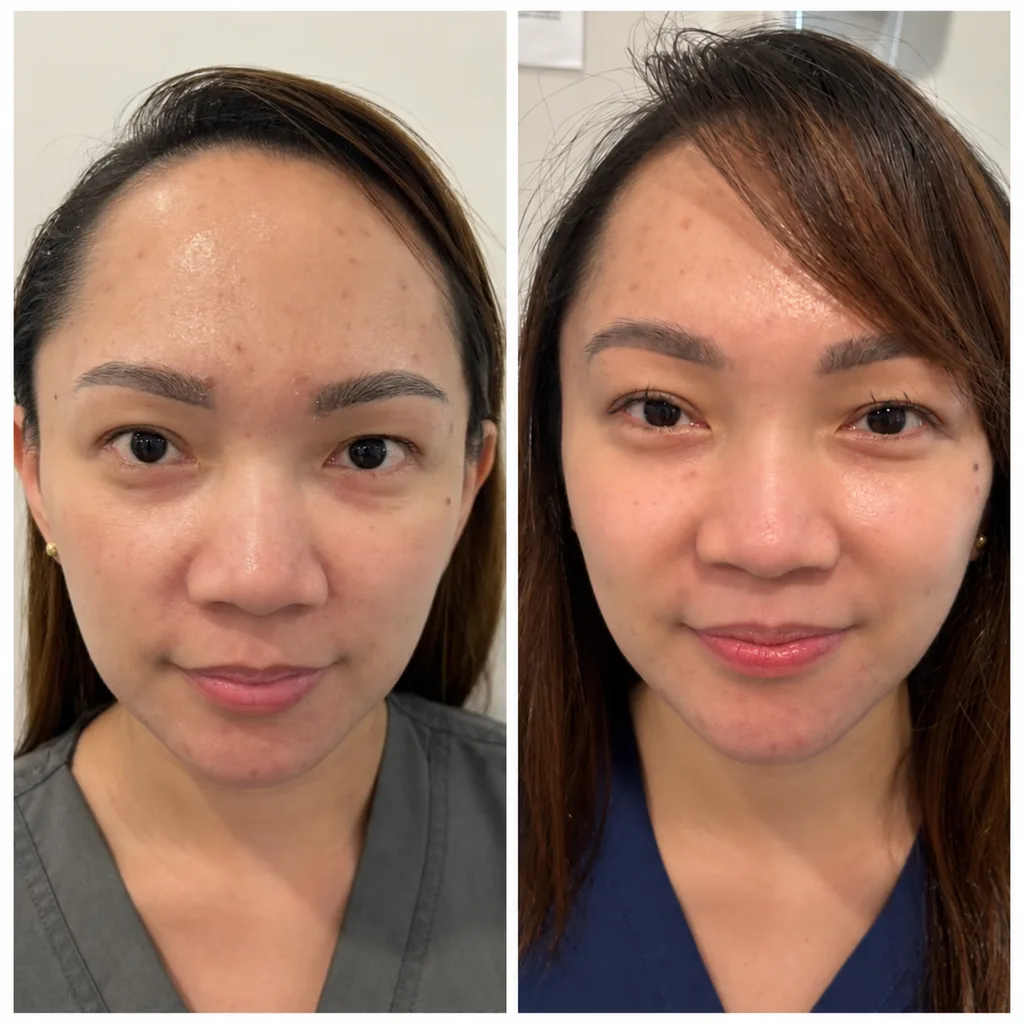
Medical Facial Before and After
Medical facial — calmer, more even and brighter skin; before (left), after (right).
* Photograph published with the patient’s written consent, in line with UAE medical advertising regulations. Individual results vary.
What Should You Do in the First 24–48 Hours?
Your stratum corneum is thinner than it was this morning and your pores are open. Both normalise within about 48 hours, and what you apply in that window decides whether the result holds or you break out.
Do — first 48 hours
- Broad-spectrum SPF 50, reapplied every 2 hours outdoors
- Fragrance-free hyaluronic acid serum
- Ceramide or squalane-based moisturiser
- Lukewarm water only when cleansing
Read moreShow less
- Drink normally and expect skin to feel slightly tight on day 1
Avoid — first 48 hours
Two Dubai-specific points. Chlorinated pool water on freshly exfoliated skin stings and dehydrates — give it 48 hours.
Read moreShow less
And moving repeatedly between 24°C air conditioning and 45°C outdoor heat strips the barrier faster than most people realise, which is a real argument for the ceramide moisturiser rather than a light gel in the days after a facial.
- Retinol, retinoids, AHAs and BHAs at home
- Physical scrubs, cleansing brushes, dermaplaning
- Heavy or occlusive makeup for the first 24 hours
- Sauna, steam room, hot yoga, and swimming pools
- Direct midday sun, waxing or threading the treated area
- Picking at anything that was not fully extracted
How Often Should You Book — and When Is a Facial the Wrong Treatment?
Cadence is straightforward. Every 4 weeks matches the skin’s turnover cycle and is the standard for congestion, oiliness and acne-prone skin. Every 6–8 weeks is enough for maintenance once things are stable. Weekly facials are not a thing — over-exfoliation causes exactly the sensitivity and reactivity people book facials to fix.
Now the honest part. There are concerns a facial will not touch, and booking a course of six for one of them wastes several thousand dirhams. If your primary concern is in the left-hand column below, a facial is not your treatment.
Facial treatments and combination plans are priced separately at consultation; no automatic facial-package discount is quoted.
If you are not sure which column you belong in, book the assessment rather than the treatment. Maryam will tell you if a facial is the right answer, and if it is not, she will say so — her assessment process exists to route you correctly, not to fill a treatment room.
| If your main concern is… | What to do instead | Why a facial cannot do it | From (AED) |
|---|---|---|---|
| Atrophic acne scarring (icepick, boxcar, rolling) | Microneedling at 1.5–2.5 mm, usually with PDRN or exosomes | Scars are dermal architecture; nothing in a facial reaches that depth | 1,000–1,300 |
| Melasma or deep pigmentation | Tranexamic acid protocol, medical peels, strict photoprotection | Pigment sits at the basal layer and dermis; surface exfoliation can worsen it | from 900 |
| Laxity or loss of firmness | RF microneedling or energy-based tightening | Requires controlled dermal injury to remodel collagen | from 1,500 |
| Grade III–IV inflammatory acne | Physician consultation and medical management first | Extraction on inflamed lesions creates scars | Consultation |
| Congestion, blackheads, dullness, dehydration | Classic deep-cleansing facial, course of 3–6 | This is exactly what a facial is for | 500 |
| Event glow in 48–72 hours | Glass-skin facial or Premium HydraFacial | Correct tool — no downtime, immediate surface result | 800 |
Frequently Asked Questions
How long does a medical facial take in Dubai?
A medical facial takes 45 to 60 minutes across seven stages: double cleanse (5 min), magnified assessment (5 min), exfoliation (8–12 min), warm softening (5–8 min), extractions (10–15 min), mask or serum infusion (10–15 min) and SPF (3–5 min). Allow an extra 15 minutes for a first appointment, when the skin assessment is longer.
What is the difference between a medical facial and a spa facial?
A medical facial follows a physician-designed protocol, is delivered by a DHA-licensed skin specialist, uses clinic-strength acids, begins with a documented skin assessment, and can escalate to peels or microneedling if the skin needs more. A spa facial has none of these. Price reflects it: AED 150–350 at a spa versus AED 500 for a Classic medical facial.
Do extractions during a facial hurt?
Extractions feel like firm pressure rather than sharp pain, and most patients rate them 2 to 4 out of 10. The nose and chin are the most sensitive areas. Correct acid exfoliation and 5–8 minutes of warm softening beforehand mean each comedone lifts with light pressure, and any lesion that does not release after two attempts is left for the next session.
Who performs the medical facial at Dr Azra Clinic?
Medical facials are performed by Maryam Siadat, a DHA-licensed Beauty Therapist and Skin Specialist with more than five years of clinical experience and internationally recognised aesthetic training. The protocols she follows are designed and overseen by Dr Azra Vaziri, DHA- and DOH-licensed aesthetic physician, who reviews any case involving unexplained pigmentation or unresponsive acne.
How much does a medical facial cost in Dubai?
Facial treatments and combination plans are priced separately at consultation; no automatic facial-package discount is quoted.
Can a medical facial remove acne scars?
No. A medical facial works on the outer layers — congestion, barrier and hydration — and does not build meaningful collagen. Atrophic acne scarring is dermal architecture and requires microneedling at 1.5 to 2.5 mm, often combined with PDRN or exosomes, from AED 1,200 per session. Facials support that work but cannot replace it.
Who should not have a medical facial?
Anyone taking oral isotretinoin now or within the past six months should not have extractions or clinic-strength exfoliation. Facials are also postponed for active cold sores, grade IV nodulocystic acne, sunburn, and recent laser, waxing or threading on the area within seven days. Topical retinoids should be stopped three to five days before a session.
What should you avoid after a medical facial?
For 48 hours after a medical facial, avoid retinoids, AHAs and BHAs at home, physical scrubs, sauna, steam rooms, hot yoga, swimming pools and direct midday sun. Avoid heavy makeup for the first 24 hours. Use a fragrance-free hyaluronic acid serum, a ceramide moisturiser, and broad-spectrum SPF 50 reapplied every two hours outdoors.
medical facial in DubaiHydraFacial vs Medical Facial vs MicroneedlingExosomes vs PDRN vs Skin BoostersMeet Maryam Siadat
Book A Medical Facial Or A Skin Assessment
Facial treatments and combination plans are priced separately at consultation; no automatic facial-package discount is quoted.
Book a Medical Facial in Dubai
Seven stages, 45–60 minutes, and a documented skin assessment before anything touches your face. Physician-designed protocol delivered by Maryam Siadat, DHA-licensed skin specialist, under the oversight of Dr Azra Vaziri.
Facial treatments and combination plans are priced separately at consultation; no automatic facial-package discount is quoted.
Book a Consultation
Dr Azra Vaziri — DHA & DOH licensed aesthetic physician with 20+ years of experience in Dubai & Abu Dhabi.