
Treatments · Hair · Dubai & Abu Dhabi
Hair Treatments in Dubai
This is the index to every hair treatment Dr Azra Vaziri offers — hair filler, exosome scalp therapy, PRP, mesotherapy and Dermapen scalp microneedling — with a short, honest description of what each one does so you can tell them apart before you book.
None of them is a default. The scalp assessment comes first, because the treatment that works for post-pregnancy shedding is not the treatment that works for inherited pattern thinning. If you want the whole programme explained end to end rather than treatment by treatment, start with hair loss treatment in Dubai.
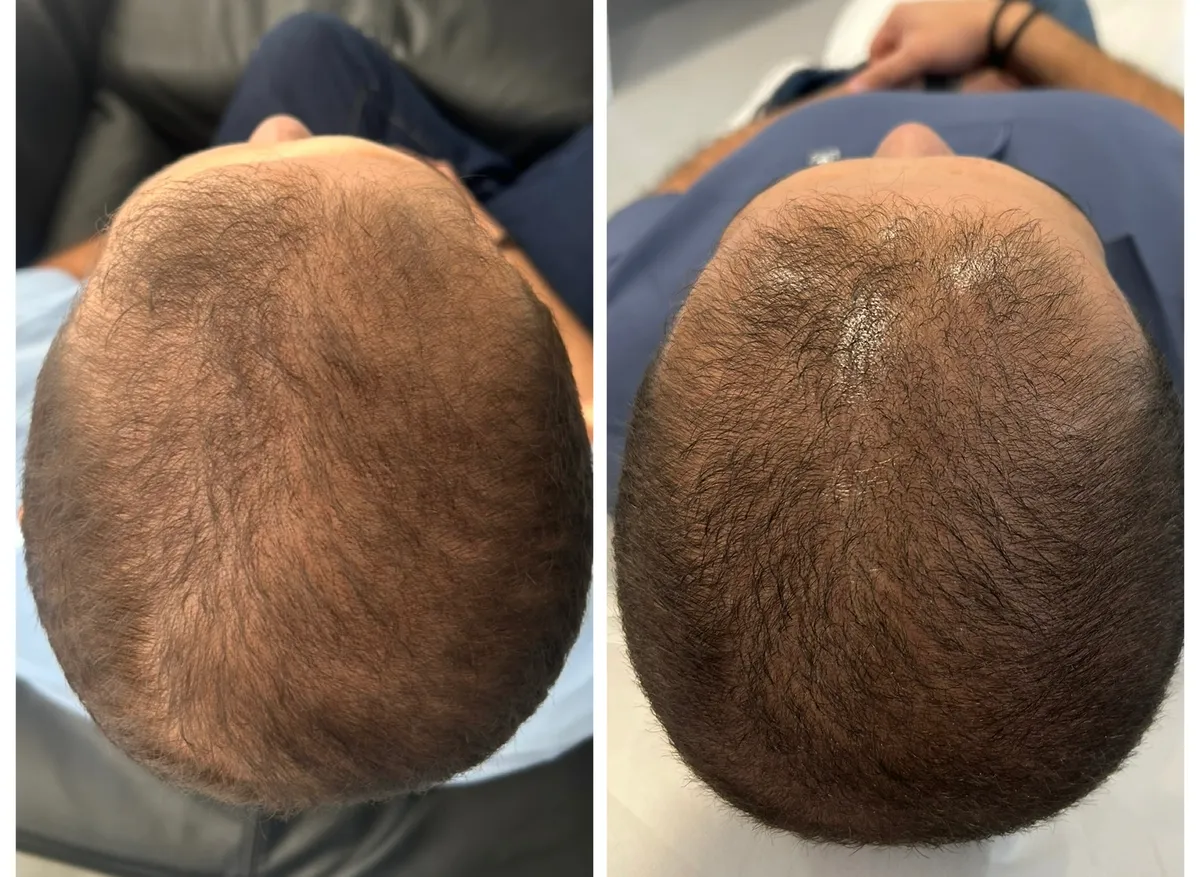
Choose Your Hair Treatment
Six treatments, each aimed at a different stage or cause. Most patients end up on a combination rather than a single one — the card below tells you what each treatment actually does, and the page behind it gives you the detail, the protocol and the pricing. If you would rather have someone narrow it down for you, start with a consultation.
Hair Loss Treatment Programme
The whole picture: how Dr Azra works out what is driving your hair loss, and how the individual therapies are layered into one plan. Start here if you do not yet know which treatment you need.
Hair Filler
Bio-mimetic peptides with hyaluronic acid injected into the scalp to revitalise weakened follicles, extend the growth phase and reduce shedding. Usually 2–4 sessions, with early change around 6–8 weeks.
Exosome Hair Therapy
Regenerative signalling molecules applied to the scalp, usually alongside microneedling, to calm inflammation and reawaken dormant follicles. Typically 3 sessions, with early change around 6–12 weeks.
PRP Therapy
Growth factors concentrated from a small sample of your own blood and returned to the scalp. Nothing foreign is introduced, which makes it a common first step for shedding and early thinning.
Scalp Mesotherapy
Vitamins, minerals and amino acids delivered directly into the scalp in a series of micro-injections. Aimed at the nutritional and circulatory side of thinning rather than the hormonal side.
Dermapen Scalp Microneedling
Controlled micro-channels that stimulate the follicle environment and let the actives above reach it. Rarely used on its own — it is the delivery step in most combination protocols.
Most patients end up on two of these rather than one. Which two is decided by what the scalp assessment finds, not by a menu — book a scalp assessment to find out where you actually are.
Looking to remove hair rather than grow it? That is a different treatment with the opposite goal. Laser hair removal with the Candela GentleMax Pro is a separate treatment aimed at long-term reduction of unwanted hair — see the laser hair removal pricing page for session details, or contact the clinic to check whether your hair and skin type suit the laser.
What Causes Hair Loss?
Hair loss is a common concern for men and women in Dubai, and it is almost never one single cause. Genetics set the baseline — androgenetic alopecia miniaturises follicles gradually, so the hair does not fall out so much as grow back finer each cycle until it stops being visible. On top of that sit the triggers that change month to month: hormonal shifts after pregnancy or through menopause, thyroid imbalance, iron or vitamin D deficiency, crash dieting, and periods of sustained stress.
Stress-related shedding — telogen effluvium — behaves very differently from inherited thinning. It pushes a large number of follicles into the resting phase at once, so the shedding arrives suddenly, usually two to three months after the event that caused it, and it is generally reversible once the trigger is removed. Inherited thinning arrives slowly and does not reverse on its own. Treating one as if it were the other is the most common reason a hair treatment disappoints.
Local factors matter too. Hard water, prolonged sun exposure, tight styling and constant air conditioning all dry the scalp and stress the hair shaft. They rarely cause hair loss by themselves, but they make an existing problem look and feel worse, and they are usually the easiest part of the picture to fix.
The key to effective treatment is identifying which of these is actually driving your hair loss. Dr Azra Vaziri performs a scalp and hair assessment before recommending anything — and where the pattern suggests a medical cause such as thyroid disease, iron deficiency anaemia or an autoimmune alopecia, blood work or a dermatology referral comes before any injectable treatment.
Which Hair Treatment Suits Which Concern
Use this as a starting point, not a prescription. The column on the left is the concern people describe in consultation; the column beside it is the treatment most often considered first for that pattern. The final plan is set after the scalp assessment and frequently combines two of them.
Still weighing two of them against each other? Read PRP vs exosome therapy and stem cell facial vs PRP vs exosomes. Polynucleotide treatment is another regenerative option Dr Azra may raise where scalp quality is the limiting factor. All of these sit inside her wider regenerative aesthetics approach. If you would rather not choose from a table, book a consultation and have the scalp assessed first.
How Hair Treatment Works
Every hair treatment at Dr Azra’s clinic follows the same cause-first sequence, whichever therapy ends up being used.
Step 1
Scalp Assessment
Dr Azra examines scalp condition, hair density, the pattern and speed of shedding, and your medical and family history — and refers for blood work where a medical cause is suspected.
Step 2
Treatment Plan
A protocol is built around the cause — hair filler, exosomes, PRP, mesotherapy or Dermapen, alone or layered — with the number of sessions and the expected timeline set out before you commit.
Step 3
Treatment Course
Treatments run as a course — commonly 4–8 sessions spaced 2–4 weeks apart, so each one lands while the follicle is still responding to the last.
Step 4
Maintenance
Maintenance sessions every 2–3 months hold the gain. Hair loss with an ongoing cause does not stay fixed on its own, so this step is part of the plan rather than an upsell.
What Results Look Like, and When
Hair grows roughly a centimetre a month, and a follicle that has been stimulated has to move through its own cycle before anything shows on the surface. That biology sets the timeline, not the treatment. Nobody sees new hair in a fortnight, and any clinic that promises it is describing something other than hair growth.
What patients usually notice first is that shedding slows — fewer hairs in the brush and on the shower floor. That is a genuine early signal, and it typically arrives well before any visible change in density. Regrowth follows later, as short new hairs at the hairline and through the part, and density becomes obvious in photographs before it becomes obvious in the mirror. This is exactly why Dr Azra takes standardised photographs at the start: memory is a poor instrument for judging your own hair.
Weeks 1–4
Nothing visible yet. The scalp may feel slightly tender for a day after each session. This is the stage most people abandon treatment — and the stage where abandoning it guarantees no result.
Weeks 6–12
Shedding typically slows and the scalp looks calmer. Hair filler tends to show early change around 6–8 weeks, exosome therapy around 6–12 weeks. Fine new growth may be visible at the hairline.
Months 3–6
The point at which density is judged. New hairs have had time to lengthen and thicken. Progress photographs are compared against the baseline and the maintenance interval is set from what they show.
Baseline photographs are taken at the first appointment, so there is something real to compare against — book a consultation to start the clock.
Results vary with the cause, the stage of loss and how consistently the course is completed. Where follicles have been dormant for years and the scalp is smooth rather than finely haired, regenerative treatment has little left to stimulate — and Dr Azra will say so at the assessment rather than after four sessions. If you are not sure how much responsive hair you still have, ask at the consultation before committing to a course.
Before & After — Real Patient Results
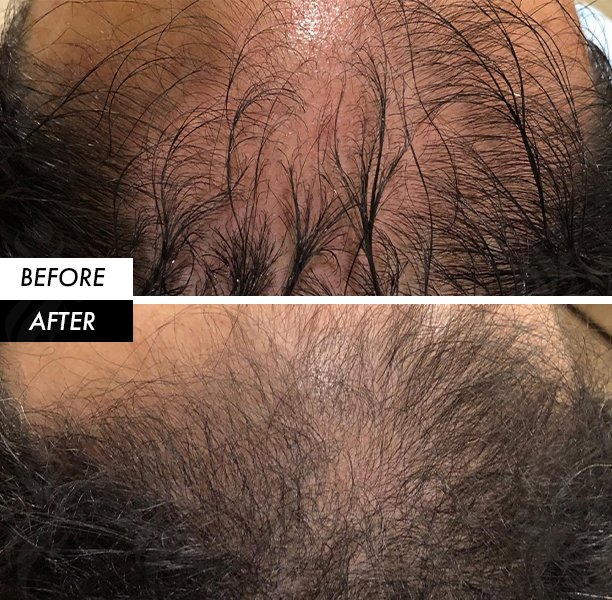
Photographs published with the patients’ written consent, in line with UAE medical advertising regulations. More hair results are shown on the hair loss treatment and exosome hair therapy pages, and further cases can be shown at your consultation.
Who Diagnoses Your Hair Loss — Dr Azra Vaziri
Hair loss is a diagnosis before it is a treatment: the same thinning can be hormonal, inflammatory or nutritional, and the treatments that work differ for each. Every assessment and session at this clinic is carried out by Dr Azra Vaziri herself — a DHA- and DOH-licensed aesthetic physician with more than 20 years of experience, practising aesthetic medicine since 2004.
- Speaker — Dubai Derma 2026, the Dubai World Dermatology and Laser Conference, presenting “Receptor & Biomimetic Exosomes — The Future of Androgenetic Alopecia Solutions” — androgenetic alopecia is the commonest cause of the thinning this page treats.
- Mesotherapy workshops — Mesoestetic Pharma Group distributor in Iran (2018–2023) — scalp injection is delivered by exactly this multi-point technique, and she ran the training for it.
- Certified by the American Academy of Aesthetic Medicine (2012), and a speaker at IMCAS World Congress 2024 in Paris.
Who Is a Good Candidate?
Hair treatments suit men and women who are shedding, thinning, or losing density — and they work best while the follicle is still alive and miniaturising rather than gone. That is the single most useful thing to understand before booking: these are treatments that revive weakening follicles, not treatments that create new ones.
Practically, that means the earlier you come the more there is to work with. A part that has widened over the last year, a crown that has thinned since a pregnancy, a hairline that has softened under stress — all of these still have responsive follicles. A scalp that has been completely smooth for a decade does not, and no injectable will change that; a surgical transplant is the honest answer there, and Dr Azra will say so.
Your Session and the Days After
A scalp session runs to roughly half an hour once you are in the chair. The area is cleansed, a topical numbing cream is applied where the protocol calls for it, and the treatment is delivered across the thinning zones in a grid so the coverage is even rather than concentrated. Injectable treatments feel like a series of quick pinpricks; microneedling feels like pressure and vibration. Neither requires sedation and both let you drive yourself home.
Afterwards the scalp is usually pink and a little tender, which settles within a day or two. The rules that matter for the first 24 to 48 hours are consistent across the treatments: leave the scalp alone, keep it clean and dry, skip the gym, the sauna and the pool, avoid direct sun, and hold off on styling products, colour and heat. What you do in those two days has a real bearing on how comfortable the recovery is — and each treatment has its own guide.
Hair treatment aftercare
The general scalp-treatment aftercare guide — washing, exercise, sun and styling, hour by hour.
Hair filler aftercare
What to expect and what to avoid after peptide hair filler injections.
Exosome hair aftercare
Including the question everyone asks — when you can wash your hair again.
Laser hair removal aftercare
For the hair-reduction treatment with the Candela GentleMax Pro.
If something does not settle in the first couple of days, contact the clinic rather than waiting for the next session.
Explore Other Treatment Categories
Frequently Asked Questions
Book a Consultation
Discuss hair restoration options in person with Dr Azra Vaziri — DHA & DOH licensed, 20+ years of experience.