Botox · Units Guide · Dubai & Abu Dhabi
How Many Units of Botox Do I Need?
The number of Botox units depends on the treatment area, your muscle strength, gender, and desired result. This guide covers every area Dr Azra Vaziri treats — with unit ranges, pricing, and the factors that affect your dose.
- 10–20 unitsForehead
- 15–25 unitsFrown lines
- 8–15 / sideCrow’s feet
- 25–50 / sideMasseter
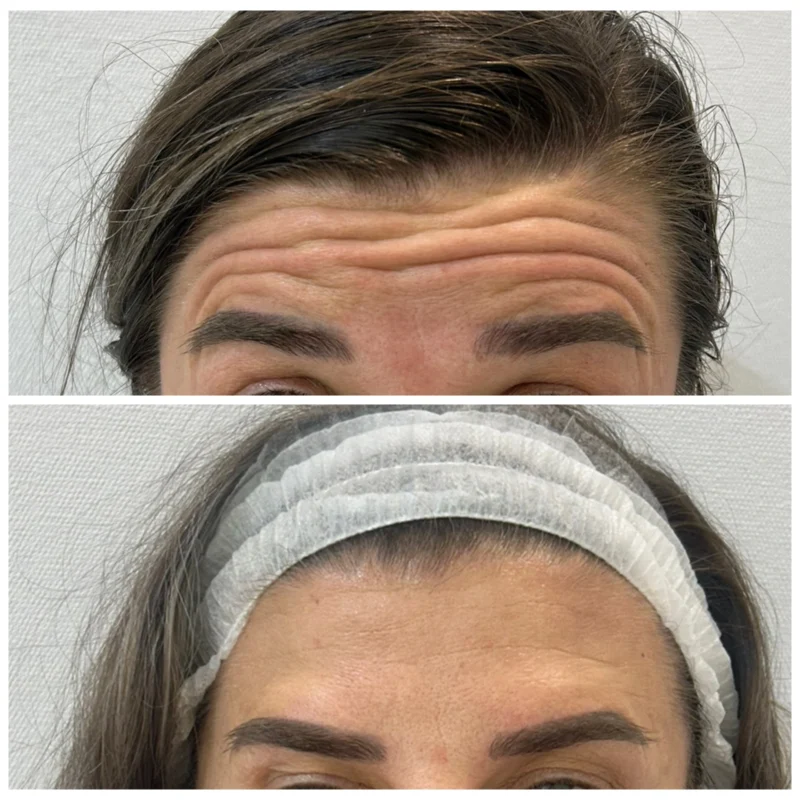
Forehead lines, before and after — treated by Dr Azra Vaziri. Shared with patient consent.
Short answer
What Is a Botox Unit?
A unit is a measure of biological activity, not of volume. Each manufacturer defines its own unit using its own potency assay, which is why units are never interchangeable between brands — one unit of Botox is not one unit of Dysport. It is also why asking for “one syringe” or “one millilitre” of Botox describes nothing useful: the same millilitre can carry 25 units or 40, depending only on how the vial was made up.
Botox arrives as a freeze-dried powder in 50-, 100- and 200-unit vials. Before treatment it is reconstituted with preservative-free 0.9% sodium chloride. A 100-unit vial made up with 2.5 ml of saline gives 4 units in every 0.1 ml — the dilution most commonly used on the face. A more dilute mix spreads further through the muscle, which is helpful in a broad flat muscle such as the frontalis and unwanted next to the eyelid, so dilution is a clinical decision rather than a default setting.
Dilutions follow the manufacturer’s reconstitution guidance. Reconstituted toxin is refrigerated and used within 24 hours, so your dose is drawn up on the day of your appointment — never in advance.
| Vial size | Saline added | Units per 0.1 ml | Units per 1 ml |
|---|---|---|---|
| 50 units | 1.25 ml | 4 units | 40 units |
| 100 units | 2.5 ml | 4 units | 40 units |
| 100 units | 4 ml | 2.5 units | 25 units |
| 200 units | 5 ml | 4 units | 40 units |
Units by Treatment Area
Men typically require 20–30% more units than women due to stronger muscles. These are Botox unit ranges — Dysport uses 2.5–3x the units for the same effect. Brand comparison →
| Area | Women | Men | Price (AED) |
|---|---|---|---|
| Forehead | 10–15 | 15–20 | 700–1,500 (std from 900) |
| Frown lines (11s) | 15–20 | 20–25 | 700–1,500 (std from 900) |
| Crow’s feet (per side) | 8–12 | 12–15 | 700–1,500 (std from 900) |
| Masseter (per side) | 25–40 | 40–50 | 1,400–3,000 |
| Lip flip | 4–6 | 6–8 | 400–1,000 |
| Nefertiti lift | 20–30 | 30–40 | 1,400–3,000 |
| Bunny lines | Price on consultation | Price on consultation | |
| Gummy smile | 4–8 | 200–600 (std from 300) | |
| Hyperhidrosis (per area) | 50–100 | 1,400–3,100 | |
| Trapezius (per side) | 40–60 | 1,600–3,500 |
Why the Ranges Are Ranges: Muscle by Muscle
Every number in the table above is a range because the muscle underneath it varies from person to person — in size, in thickness, and in how hard it pulls. Understanding which muscle is being treated explains the spread better than any average.
Frontalis — the forehead
One broad, flat, thin sheet that lifts the brow.
Read moreShow less
It is wide, so it needs several injection points; it is thin, so each point needs little. The range widens with forehead height and with how strongly you raise your brows. It is never treated alone — relaxing the lifter without relaxing the depressors below can drop the brow.
Corrugator and procerus — the 11s
A small but genuinely powerful complex that pulls the brows together and down.
DetailsShow less
Strength here varies more between individuals than anywhere else on the upper face, which is why the frown line range is comparatively wide and why under-dosing shows up so quickly.
Orbicularis oculi — crow’s feet
A ring muscle around the eye.
Read moreShow less
Only the outer fibres are treated, and each side is dosed separately, so the figure quoted is always per side. Dose is kept deliberately low and superficial near the lower lid to avoid affecting the smile.
Masseter — the jaw
One of the strongest muscles in the body, and thick rather than flat.
DetailsShow less
It needs a large dose in a deep plane, which is why the masseter figure dwarfs every facial area. A visibly bulky masseter from years of clenching sits at the top of the range; a slim one sits well below it.
Platysma — neck and jawline
A wide, thin sheet running from the collarbone to the jaw.
DetailsShow less
Treated along its bands rather than across the whole sheet, which is why the Nefertiti lift total depends on how many bands are visible when you tense, not on neck size.
Trapezius — the shoulders
The largest muscle treated with botulinum toxin at all, and dosed per side.
DetailsShow less
The trapezius range reflects build and training history far more than gender alone — a lifter and a desk worker of the same height can differ substantially.
What Affects Your Dosage
The ranges above are guidelines. Your actual dose is determined during consultation based on several factors:
More Units Needed
- Male patients (stronger, thicker muscles)
- First-time treatment (muscles at full strength)
- Deep static lines already present
- Large treatment areas (forehead, masseter, trapezius)
- Desire for complete line elimination
Fewer Units Needed
Which of these apply to you is settled at a consultation.
- Female patients (finer muscles)
- Repeat patients (muscles already weakened)
- Preventative approach (treating before lines deepen)
- Baby Botox (micro-dose for natural movement)
- Preference for subtle softening over complete freeze
Botox vs Dysport vs Xeomin: Unit Conversion
The unit ranges in the table above refer to Botox (onabotulinumtoxinA). If you are considering Dysport or Xeomin, the conversion is straightforward:
Botox
onabotulinumtoxinA
1 unit
Same 1:1 ratio as Botox
Despite the different unit counts, the total cost is comparable across brands because Dysport is priced lower per unit. Dr Azra selects the brand based on your treatment history, area, and clinical needs — not price. Read the full Botox vs Dysport vs Xeomin comparison.
First-Time Botox: What to Expect
If this is your first time, Dr Azra typically starts with a conservative dose — slightly below the upper range for your area. This allows her to assess how your muscles respond and fine-tune at the 2-week review. It is always easier to add a few units than to over-treat on the first session.
Most first-timers begin with the upper face — forehead, frown lines, and crow’s feet. These three areas combined typically require 30 to 50 units for women and 45 to 60 for men. For a broader overview of injectable options for lines, see wrinkle treatment Dubai. For patients in their late 20s to early 30s interested in preventative treatment, a Baby Botox approach with even lower doses is ideal.
Results appear within 3 to 7 days. Full effect at 2 weeks. Duration is 3 to 6 months depending on area and individual metabolism. For post-treatment guidance, see the Botox aftercare guide.
Under-Dosed or Over-Dosed: How to Tell
Both errors are dose errors, and both are judged at the two-week review rather than on day three. Knowing what each one looks like is the fastest way to have a useful conversation at that appointment.
Signs the dose was too low
The fix is small and additive: a top-up of a few units at the review, in the specific point that is still pulling.
- Lines soften but never fully settle, even at the two-week mark
- Movement returns noticeably before the eight-week point
- One side moves more than the other because a stronger muscle needed more
Read moreShow less
- The treated area looks improved in photographs but unchanged in the mirror when you animate
Signs the dose was too high
There is no reversal agent, so this one is only managed by waiting. It settles as the effect wears off, and the next session is dosed lower. This is precisely why a first treatment is deliberately conservative.
- A heavy or tight feeling across the brow, particularly late in the day
DetailsShow less
- The brow sits lower than usual, or the eyelid feels loaded
- The outer brow lifts sharply while the centre stays flat
- Expression reads as blank rather than rested in conversation
Is There a Limit? Unit Ceilings and Intervals
Yes. The manufacturer’s guidance is that the cumulative dose should not exceed 400 units in any three-month interval, counting every area treated, for every indication. Cosmetic facial dosing sits far below that ceiling — a full upper face is a fraction of it — but it becomes relevant when large muscles are involved, which is why the masseter, trapezius and hyperhidrosis doses are planned together at your consultation rather than booked piecemeal.
The second limit is time, not quantity. Sessions are spaced a minimum of three months apart. Treating sooner in an attempt to chase a faster or stronger result raises the cumulative dose without adding benefit, and repeated short-interval dosing is the setting in which neutralising antibodies — the mechanism behind toxin genuinely losing its effect — are most often discussed. If your results seem to be fading earlier than they used to, see why Botox stops working before adding units.
For context, the licensed cosmetic doses are 20 units for the glabellar (frown) lines, 24 units total for crow’s feet — 12 per side — and 20 units for forehead lines when treated alongside the glabellar complex. Real-world ranges vary around those figures because real muscles do, and a dose is always set on the muscle in front of the injector rather than on a label.
Maintenance: Do I Need the Same Units Every Time?
Not necessarily. With regular treatment every 3 to 6 months, many patients find their muscles gradually weaken and they can maintain results with fewer units. This is one of the benefits of consistent treatment — over time, the muscles “learn” to contract less forcefully.
However, if you skip sessions for an extended period, the muscles return to full strength and you may need the original dose again. Dr Azra re-assesses at each visit and adjusts units accordingly. For patients concerned about myths around dependency or “needing more over time,” see our Botox myths vs facts article.
Do More Units Last Longer?
Up to a point, and then no. Inside the effective range, a dose matched properly to a strong muscle does hold longer than a dose that was too small for it — which is the real reason a well-dosed masseter or frown line treatment often outlasts a light forehead. Past the point where the muscle is adequately treated, extra units stop buying time and start buying only stiffness and cost.
What actually sets duration
- The size and strength of the muscle treated
- Whether the dose was adequate for that muscle
- Your metabolism and activity level
- How consistently you have been treated before
What does not
- Adding units beyond the effective dose
- Choosing a different brand for the same effect
- Shortening the interval between sessions
- A higher price for the same area
Typical spread
Ranges narrow once you have had two or three consistent sessions and your own pattern is known.
- Upper face: 3–4 months
- Masseter: 4–6 months
- Lip flip: 6–10 weeks
- Hyperhidrosis: 4–6 months
Frequently Asked Questions
How many units of Botox for forehead?
Women typically need 10 to 15 units, men 15 to 20. The frontalis muscle covers the entire forehead, so the exact number depends on its size and strength. Dr Azra uses the minimum needed for a smooth but natural result.
How many units of Botox for frown lines?
Women: 15 to 20 units. Men: 20 to 25. The corrugator and procerus muscles that cause the 11s between the brows are strong. Under-dosing leads to poor results, which is why Dr Azra matches the dose to your muscle strength.
How many units for crow's feet?
8 to 12 units per side for women, 12 to 15 for men. Both sides are treated, so total is 16 to 30 units. Crow’s feet are among the first lines to develop, especially in Dubai’s sun.
How many units for masseter Botox?
25 to 40 units per side for women, 40 to 50 for men. The masseter is one of the strongest muscles in the body. Used for jaw slimming, bruxism, and TMJ. Both sides treated, so total is 50 to 100 units.
Do men need more Botox than women?
Yes, typically 20 to 30 percent more. Men have thicker skin and stronger facial muscles, requiring more units for the same effect. Dr Azra adjusts dosing for male anatomy.
Are Botox and Dysport units the same?
How much does Botox cost per unit in Dubai?
Dr Azra prices by treatment area rather than per unit, ensuring transparent pricing. Treatments range from AED 200 (gummy smile) or AED 400 (lip flip) to AED 3,500 (trapezius); hyperhidrosis ranges up to AED 3,100. See the full Botox price guide. Consultation confirms your exact price.
Will I need the same units every time?
Not necessarily. With regular treatments, muscles gradually weaken and many patients maintain results with fewer units over time. First-time patients may also need a slight adjustment at the 2-week review. See Botox myths vs facts for more on this topic.
What is a unit of Botox?
A unit measures the toxin’s biological activity, defined by each manufacturer’s own potency assay — it is not a measure of volume. That is why units are brand-specific: one Botox unit is not one Dysport unit, and why “one syringe” describes nothing without knowing the dilution.
How many units are in a vial of Botox?
Botox is supplied in 50-, 100- and 200-unit vials. A 100-unit vial reconstituted with 2.5 ml of saline gives 4 units per 0.1 ml, or 40 units per millilitre. The same vial made up with 4 ml gives 2.5 units per 0.1 ml, so millilitres alone never tell you the dose.
Where to go next
Read next: the treatment page, Botox in Dubai and all options in this area, Face Treatments in Dubai.
See also: How much Botox costs in Dubai (2026).
Book a Consultation
Dr Azra Vaziri — DHA & DOH licensed aesthetic physician with 20+ years of experience in Dubai & Abu Dhabi.