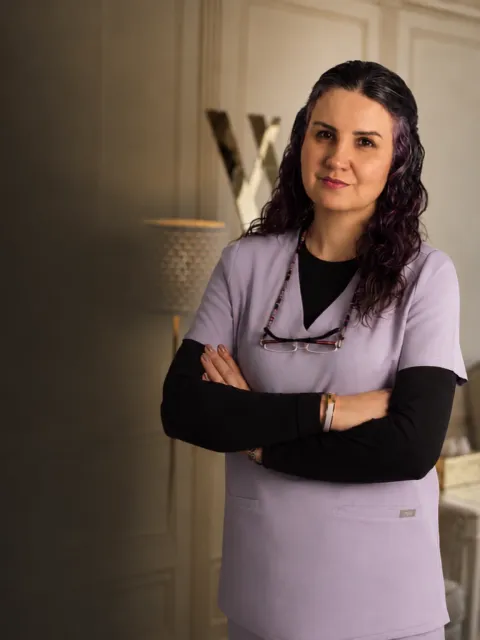
Botox · Preventative Guide
Preventative Botox: When to Start
Preventative Botox means starting treatment before deep wrinkles set in — training muscles not to create the creases that become permanent lines. Dubai’s year-round UV makes it particularly relevant here. Dr Azra Vaziri explains when preventative Botox makes sense, which areas to treat first, and when it is better to wait.
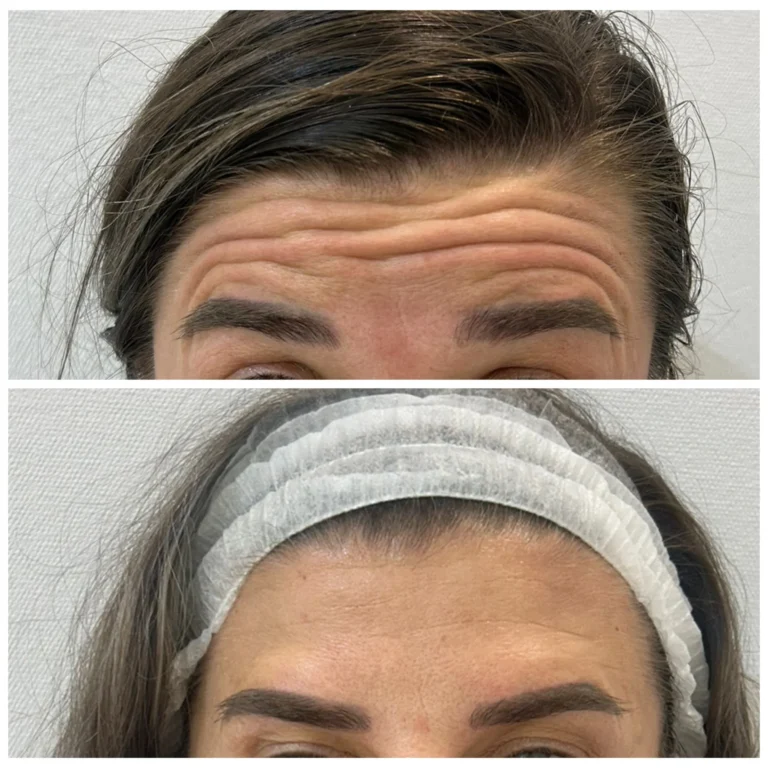
Forehead Botox, before and after — treated by Dr Azra Vaziri. Shared with patient consent; individual results vary.
The Right Time to Start
There is no magic age. The right time depends on your genetics, muscle activity, sun exposure, and when you start noticing lines at rest.
Dubai & Abu Dhabi · Assessment first — Dr Azra will tell you if it is too early.
Good Time to Start
- Lines visible at rest that were not there before
- Strong muscle movement creating deep creasing when expressing
- Family history of early wrinkles
Read moreShow less
- High sun exposure or outdoor lifestyle in Dubai
- Late 20s to early 30s for most people
Too Early / Not Needed Yet
At your consultation, Dr Azra will tell you honestly if Botox is not needed yet.
Read moreShow less
Dr Azra’s philosophy: Start when there is a clinical reason, not because of your age alone. If lines are forming at rest, treatment prevents them from deepening. If no lines are present, good skincare, SPF, and patience are better than premature Botox. Baby Botox (micro-doses) is a great starting point for those ready to begin.
- No visible lines at rest
- Minimal muscle activity when expressing
- Under 25 with good skin quality
- Starting purely due to social media pressure
- Good skincare and SPF already in place
How Preventative Botox Works
Every time you frown, squint, or raise your eyebrows, the underlying muscles contract and fold the skin above them. In your 20s, the skin bounces back. By your 30s, these repeated folds begin etching into the skin as static lines — visible even when your face is at rest.
Preventative Botox works by relaxing these muscles before the etching becomes permanent. The muscles still move, but with less force — reducing the depth and frequency of the folds. Over time, the skin in the treated area has the chance to repair and smooth out instead of being creased thousands of times per day.
This is why preventative Botox is significantly more effective than corrective Botox. Once a line is deeply etched into the skin (a static line), Botox alone cannot remove it — the skin has been structurally damaged, and filler, skin boosters, or resurfacing treatments may be needed alongside Botox. Starting earlier avoids this situation entirely. Botox is also used for non-ageing concerns such as jaw slimming, excessive sweating, and trapezius slimming — where a preventative mindset also applies. Learn more about the science in our what causes early skin aging guide. Discuss your own pattern at a consultation.
Best Areas to Start
Most patients beginning preventative Botox focus on the upper face — the three areas where dynamic wrinkles form earliest and most visibly.
These are typical preventative starting ranges, not a prescription — they are deliberately lower than corrective doses. Dr Azra maps your own muscle pattern at your consultation. See the full unit dosage guide for every area.
Other Botox areas: Lip flip → · Nefertiti lift → · Bunny lines → · Gummy smile →
| Area | Muscle & why it creases first | Preventative dose |
|---|---|---|
| Forehead lines | Frontalis — the only muscle that lifts the brows, so it fires every time you raise them. Usually the first area patients notice. | 5 to 15 units |
| Frown lines (11s) | Corrugator and procerus — strong, deep muscles that fire during concentration, squinting and screen use, so the crease etches early. | 10 to 20 units |
| Crow’s feet | Orbicularis oculi — the skin here is the thinnest on the face, and Dubai sunlight keeps you squinting through it all year. | 4 to 10 units per side |
Preventative Botox vs Baby Botox
These terms overlap but are not identical. Preventative Botox refers to the timing — starting treatment before deep wrinkles form. Baby Botox refers to the dose — using fewer units for a more subtle, natural result. You can have Baby Botox at 45 as a corrective choice, and you can start preventative Botox at 28 with a standard dose; the two simply describe different things.
In practice, most patients beginning preventative Botox use a Baby Botox approach — lower doses that soften muscle movement without freezing expression. This is ideal for patients in their late 20s to early 30s who want to slow aging while maintaining a completely natural look.
For more on common misconceptions, see our Botox myths vs facts guide. And for a full breakdown of doses per area, see how many units of Botox.
What Preventative Botox Can — and Cannot — Do
Starting early is a genuinely powerful strategy, but it is one tool and not a whole anti-aging plan. Knowing the limits up front is what keeps expectations realistic.
What It Can Do
- Soften dynamic lines while they are still movement-only
- Slow a forming static line from deepening further
- Keep expression natural when doses are kept conservative
- Reduce the squinting and frowning habit that drives creasing
- Often require fewer units over time as the muscle deconditions
What It Cannot Do
If a line is already etched, Dr Azra will say so at your consultation and talk through the other options.
- Erase a line that is already deeply etched at rest
- Improve skin texture, pigmentation or sun damage
- Replace daily SPF, sleep and a sensible skincare routine
Read moreShow less
- Restore volume loss or address changes in facial bone structure
- Lift skin laxity — that is a different set of treatments
Who Should Wait or Avoid It
Botulinum toxin is not suitable during pregnancy or breastfeeding, if you have a neuromuscular condition such as myasthenia gravis or Lambert–Eaton syndrome, if there is an active skin infection at the injection site, or if you have had a reaction to the toxin or its components before.
DetailsShow less
Tell Dr Azra about any medication you take — some antibiotics and muscle relaxants interact with botulinum toxin.
Side effects at preventative doses are usually minor and short-lived: pinpoint redness, an occasional small bruise, or a mild headache for a day or two. Temporary brow or eyelid heaviness is uncommon and resolves as the effect wears off. Raise anything that concerns you when you book your consultation.
Why Dubai Residents Age Faster — and What to Do About It
Dubai’s environment accelerates skin aging in ways that make preventative Botox particularly relevant:
These factors mean patients in Dubai may benefit from starting preventative Botox earlier than those in milder climates. Combining Botox with daily SPF, good skincare, and strategies to slow skin aging creates a comprehensive anti-aging approach. For a broader overview of treatment options for lines, see wrinkle treatment Dubai. See also our guide on what causes early skin aging.
- UV exposure — year-round high UV index breaks down collagen and elastin faster than temperate climates
- Squinting — intense sunlight causes constant periorbital muscle contraction, accelerating crow’s feet
- Air conditioning — constant cycling between outdoor heat and indoor AC dehydrates the skin
- Hard water — high mineral content in Dubai tap water can compromise the skin barrier
What to Expect at Your First Appointment
Assessment — Dr Azra evaluates your facial muscles at rest and during expression. She identifies which areas are developing dynamic lines and whether those lines are beginning to etch into static wrinkles. If no lines are present at rest, she may advise waiting.
Treatment — If preventative Botox is appropriate, Dr Azra uses conservative doses — typically lower than corrective treatment. She selects the right product — Botox, Dysport, or Xeomin — and uses the minimum units needed to reduce muscle activity without eliminating natural expression. The procedure takes 10 to 15 minutes. See the full brand comparison →
Results — Results appear within 3 to 7 days and settle fully at about two weeks. The effect is subtle — your face looks refreshed and smooth, not frozen. Results last 3 to 6 months. With regular maintenance, many patients find they need fewer units over time as the muscles gradually weaken.
For post-treatment guidance, see our Botox aftercare guide, and for Dubai pricing see the Botox price guide. When you are ready, book a consultation at the Dubai clinic and Dr Azra will tell you whether it is the right moment to begin.
Frequently Asked Questions
What is preventative Botox?
Preventative Botox means starting treatment before deep wrinkles form. By relaxing muscles early, you train them not to create the repetitive creases that become permanent static lines over time. It slows the aging process rather than reversing it.
When should I start preventative Botox?
There is no universal age. The right time is when you notice lines at rest that were not there before, strong muscle movement creating deep creases, or a family history of early wrinkles. For most people this is late 20s to early 30s. Dr Azra assesses individually during consultation.
Which areas should I treat first?
The forehead (horizontal lines) and glabella (frown lines / 11s) are the most common starting areas because these muscles are among the most active. Crow’s feet around the eyes are also frequently treated early. Dr Azra recommends starting with the areas showing the most dynamic activity.
Is preventative Botox the same as Baby Botox?
They overlap but are not identical. Baby Botox refers to using lower doses for subtle results. Preventative Botox refers to the timing — starting before deep lines form. Many patients begin with Baby Botox as their preventative approach, using micro-doses for a natural look.
How many units do I need for preventative Botox?
Preventative doses are typically lower than corrective doses. Forehead: 5 to 15 units. Frown lines: 10 to 20 units. Crow’s feet: 4 to 10 units per side. See the full unit dosage guide for all areas.
Can I start too early?
Yes. If no lines are visible at rest and muscle activity is normal, Botox is unnecessary. Good skincare, daily SPF, and patience are better than premature treatment. Dr Azra will advise honestly if it is too early.
Who should not have preventative Botox?
Botulinum toxin is avoided during pregnancy and breastfeeding, in neuromuscular conditions such as myasthenia gravis or Lambert–Eaton syndrome, where there is an active infection at the injection site, and in anyone who has reacted to the toxin before. Tell Dr Azra about your medications at your consultation — some antibiotics and muscle relaxants interact with it.
How often do I need preventative Botox?
Every 3 to 6 months initially. With regular treatment, many patients find they need less frequent sessions as the muscles gradually weaken and lines soften over time. See the aftercare guide for post-treatment tips.
Where to go next
Read next: the treatment page, Botox in Dubai and all options in this area, Face Treatments in Dubai.
Book a Consultation
Dr Azra Vaziri — DHA & DOH licensed aesthetic physician with 20+ years of experience in Dubai & Abu Dhabi.