What Is PDRN? The Viral Treatment Explained
PDRN (polydeoxyribonucleotide) is the active compound behind the “salmon DNA facial” — short, purified DNA fragments that activate your skin’s own repair pathways. Originally developed for wound healing, it is now one of the most evidence-backed regenerative treatments in aesthetic medicine. It stimulates collagen, repairs the skin barrier, and hydrates from within.
Available as part of the Dermapen Exosome/PDRN protocol from AED 1,200/session (standard AED 1,700) with PDRN, or AED 1,300 (standard AED 1,900) with exosomes.
- 50–200nucleotides per PDRN chain
- A2Aadenosine receptor pathway
- 20+ yrsclinical use in regenerative medicine
- 3–4sessions in a typical course
In Simple Terms
Written and reviewed by
DHA & DOH licensed aesthetic physician · Dubai & Abu Dhabi · Updated August 2026
PDRN has gone from a niche regenerative medicine ingredient to one of the most searched aesthetic treatments in the world. This guide explains the molecular science, the clinical evidence and the practical reality of PDRN in 2026 — including how Dr Azra Vaziri uses it in Dubai and Abu Dhabi.
What This Guide Covers
- What PDRN is, and what it is not
- The adenosine A2A pathway, step by step
- PDRN vs polynucleotides (PN) — the real difference
- What it treats, how it is delivered, what results look like
- Safety, side effects and what PDRN cannot do
What PDRN Actually Is
PDRN stands for polydeoxyribonucleotide — a mouthful that simply means: short, purified fragments of DNA. Specifically, PDRN consists of DNA chains between 50 and 200 nucleotides long, extracted and purified from the reproductive cells (gonads) of salmon or trout.
These are not living cells, not whole DNA, and not genetic material that could alter your own DNA. They are inert, highly purified molecular fragments that function as biological signalling molecules when introduced into tissue. Think of them as keys that unlock specific repair pathways in your cells.
PDRN is not new. It has been used in regenerative medicine since the early 2000s — primarily in wound healing, orthopaedics, and diabetic ulcer treatment in South Korea, Italy, and Japan. Its migration into aesthetic medicine happened when clinicians noticed that the tissue-repair properties that healed wounds also improved skin quality, stimulated collagen, and reversed signs of ageing.
It is the active compound behind the viral “salmon DNA facial” that appears in TikTok videos, Korean beauty clinics, and increasingly in aesthetic practices across Dubai, Abu Dhabi and the wider Gulf. The social-media name is a simplification; the molecule underneath it is a well-characterised regenerative medicine ingredient with a paper trail that long predates the trend.
What PDRN is
Purified, fragmented salmon or trout DNA, 50–200 nucleotides long, suspended in a sterile injectable or topical solution. A signalling molecule.
What PDRN is not
Not a filler, not a stem-cell product, not living tissue, and not genetic material that can interact with your own DNA in any way.
Why salmon?
Salmon and trout DNA is roughly 95% homologous with human DNA, is available at pharmaceutical scale, and purifies to a protein-free, non-immunogenic product.
How PDRN Works: The Adenosine A2A Pathway
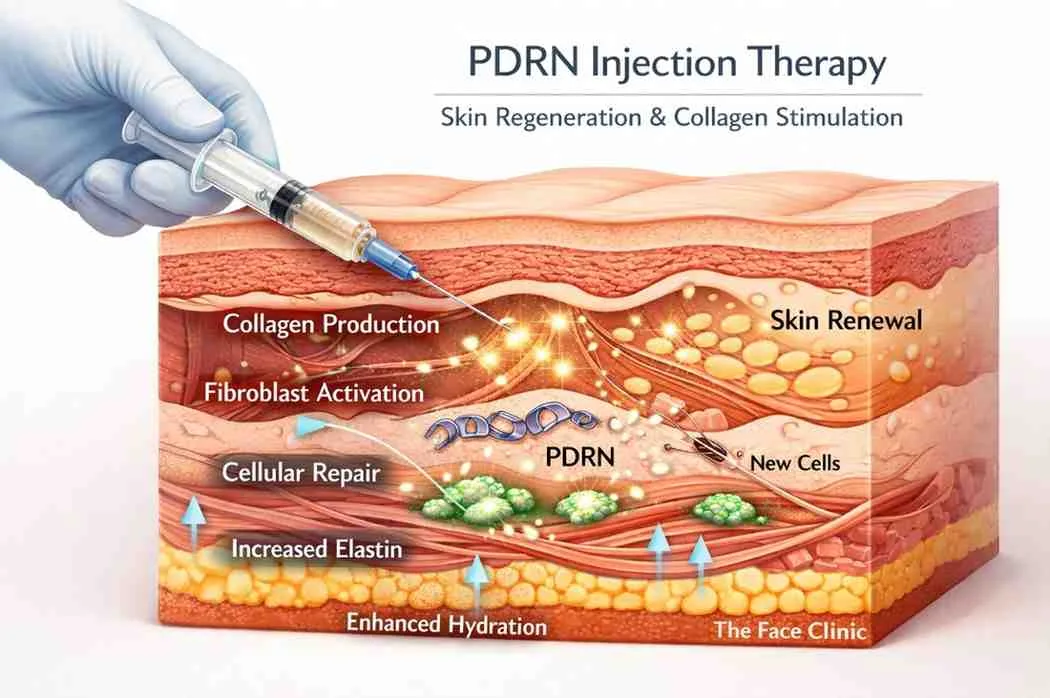
PDRN’s primary mechanism of action is through the adenosine A2A receptor pathway. Five things happen in sequence:
1 · Injection and degradation
Once PDRN is placed in the dermis, natural tissue enzymes (nucleases) begin breaking the chains down.
Read moreShow less
That degradation releases individual nucleotides and nucleosides — including adenosine.
2 · Receptor activation
The released adenosine binds A2A receptors on fibroblasts and other cells, switching on an intracellular cascade that drives cell proliferation, tissue repair and an anti-inflammatory response.
3 · Fibroblast activation
Activated fibroblasts increase production of collagen (types I and III), elastin and glycosaminoglycans
Read moreShow less
— the structural molecules behind firmness, elasticity and dermal hydration.
4 · Anti-inflammatory effect
PDRN simultaneously suppresses pro-inflammatory cytokines (TNF-alpha, IL-6) while promoting anti-inflammatory mediators. This is why it suits damaged, reactive or post-procedure skin.
5 · Salvage pathway
The nucleotide building blocks released during degradation are recycled through the cell’s “salvage pathway”, supplying raw material for DNA repair and cell division in tissue damaged by UV, inflammation or ageing.
Why the mechanism matters
Because PDRN signals rather than fills, the change it produces is your own new collagen and a repaired barrier
Read moreShow less
— which is why results build over weeks instead of appearing on the day.
PDRN vs Polynucleotides (PN): What Is the Difference?
This is one of the most common points of confusion. Both terms appear in marketing material, often interchangeably. Here is the actual distinction:
PDRN (polydeoxyribonucleotide) refers specifically to short DNA fragments, typically 50–200 nucleotides in length. PDRN has a well-documented mechanism through the adenosine A2A receptor. Products like Rejuran contain PDRN.
PN (polynucleotide) is a broader term that includes longer DNA chains — typically 200–2,000+ nucleotides. Polynucleotides still activate fibroblasts and stimulate collagen, but through a combination of mechanisms that include but are not limited to the A2A pathway. Products like Plinest contain PN.
In practice, the clinical outcomes of PDRN and PN products are similar — both improve skin quality, stimulate collagen, hydrate, and repair the barrier. The choice between them often comes down to brand preference, formulation, and clinical experience rather than a meaningful difference in results for the patient. For how polynucleotides compare to another regenerative option, see polynucleotides vs exosomes.
Not sure whether PDRN or a longer-chain polynucleotide suits your skin? Ask Dr Azra at your consultation.
| Factor | PDRN | PN (Polynucleotide) |
|---|---|---|
| Chain length | Short (50–200 nucleotides) | Long (200–2,000+ nucleotides) |
| Primary mechanism | Adenosine A2A receptor activation | Multiple pathways including A2A |
| Water binding | Moderate | Strong (longer chains bind more water) |
| Key brands | Rejuran, Ameela/TwAc | Plinest (Fast, Strong) |
| Source | Salmon gonad | Trout gonad (Plinest) or salmon |
| Best suited to | Barrier repair, reactive skin, thin under-eye skin | Dermal hydration, laxity, broader bioremodelling |
PDRN’s Medical History: Not Just a Beauty Trend
One thing that separates PDRN from many trendy aesthetic ingredients is its genuine medical history. PDRN has been studied and used clinically for over two decades in contexts far beyond skincare:
This medical pedigree is important. PDRN is not a cosmetic invention — it is a regenerative medicine technology that has been adapted for aesthetic use because the same tissue-repair mechanisms that heal wounds also rejuvenate ageing skin. For more on the aesthetic applications, see our salmon DNA facial guide and our best regenerative treatments overview.
It is worth being clear about where the evidence is strongest. PDRN’s deepest published record sits in wound healing and tissue repair — the fields it was developed for. The aesthetic literature is younger and smaller, drawn largely from South Korea and Italy, and it consistently reports improvements in skin quality, hydration and elasticity rather than the volume or lifting changes that fillers and energy devices produce. That is the honest shape of the evidence: strong on repair, real but more modest on rejuvenation, and not a substitute for treatments that do a different job. For a critical look at the marketing around this category, read polynucleotides: hype vs reality.
- Diabetic ulcer healing — one of the earliest and most researched applications, showing significantly accelerated wound closure
- Orthopaedic medicine — used to support cartilage and tendon repair
- Post-surgical wound healing — accelerating tissue repair after surgery
- Burns treatment — promoting skin regeneration in burn patients
- Dental medicine — supporting tissue regeneration after oral surgery
- Hair restoration — stimulating follicle activity and growth
What PDRN Treats in Aesthetic Medicine
In an aesthetic context, PDRN is used to address six main concerns:
Skin ageing and quality decline
Stimulates collagen and elastin production and improves skin thickness, firmness and elasticity. This is the core anti-ageing application.
Dehydration and dullness
Water-binding capacity restores dermal hydration, producing the plump, dewy quality associated with glass skin. For a lighter hydration option, compare with skin boosters.
Under-eye concerns
Rejuran I is designed for the periorbital area. PDRN improves skin thickness and quality under the eyes without adding volume. See our dark circles guide and Innovyal Undereye.
Barrier damage
The anti-inflammatory and repair properties suit sensitised, reactive or environmentally stressed skin — especially relevant in Dubai’s UV and AC-heavy environment.
Acne scarring
PDRN improves the overall quality of scarred skin and is often used alongside RF microneedling for collagen remodelling in acne scar treatment.
Hair restoration
Scalp injections can support hair growth by stimulating follicular activity and improving the scalp microenvironment.
How PDRN Treatment Is Administered
PDRN can be delivered through three main routes, chosen according to the treatment goal:
Micro-injections
PDRN is injected directly into the dermis with fine needles in a grid pattern across the treatment area.
Read moreShow less
This is the most common method for standalone PDRN sessions on the face, under-eye, neck and hands.
Dermapen Exosome/PDRN protocol
PDRN solution is applied topically during Dermapen microneedling, so the fragments pass through the micro-channels the device creates.
Read moreShow less
Available as the DermaPen Exosome/PDRN session (PDRN AED 1,200, standard AED 1,700; exosome AED 1,300, standard AED 1,900). Afterwards, follow our Dermapen aftercare guide.
Scalp injections
For hair restoration, PDRN is injected at the follicular level to stimulate dormant follicles and improve the scalp microenvironment.
Read moreShow less
A topical anaesthetic is applied before all injectable sessions. Treatment time is typically 30–45 minutes. Most patients resume normal activities immediately, and the small injection points settle within a day or two.
PDRN Results — What to Expect
Individual results vary depending on skin condition, age, lifestyle, and treatment protocol. Most patients complete 3–4 sessions spaced 3–4 weeks apart for optimal outcomes.
| Timeline | What to Expect |
|---|---|
| Day 0 – 3 | Small injection marks or mild redness (resolves within 24–48 hours). Slight skin tightness may be felt. |
| Weeks 1 – 2 | Improved hydration and early glow visible. Skin feels smoother and more supple. |
| Weeks 3 – 6 | Collagen stimulation becomes clinically visible — improved firmness, reduced fine lines, better skin texture. |
| Months 2 – 3 | Full collagen remodelling from a complete treatment course. Barrier function and overall skin quality significantly improved. |
| Months 6 – 12 | Results sustained. Maintenance sessions every 6–12 months recommended to preserve improvements. |
Safety, Side Effects and What PDRN Cannot Do
PDRN has an unusually clean safety profile for an injectable, largely because the purification process strips out proteins and cellular material and leaves a non-immunogenic molecule behind. That does not make it side-effect free, and it does not make it the right answer to every concern. Both halves matter when you are deciding whether to book.
Expected, and short-lived
- Pinpoint injection marks across the treated area
- Mild redness and warmth for a few hours
- Small raised bumps at each injection point that flatten within hours
- Mild swelling and tenderness, most noticeable around the eyes
Less common
Allergic reactions are extremely rare because purification removes the fish proteins that would trigger them, but a known fish or seafood allergy should always be declared at consultation so the product choice can be discussed.
Read moreShow less
PDRN is not carried out over an active skin infection or an active inflammatory breakout in the treatment area, and it is avoided during pregnancy and breastfeeding as a precaution rather than because harm has been demonstrated.
Aftercare is simple. Leave the skin bare for the rest of the day, skip the gym, sauna, steam room and hot yoga for 24–48 hours, pause acids and retinoids for three to five days, and use a high-factor sunscreen — the skin is in an active repair phase and UV works directly against it.
- Bruising — more likely in the thin under-eye skin
- Temporary firmness or lumpiness at injection points lasting a few days
- A short flare of sensitivity in reactive skin
- Infection at an injection site — rare, and why sterile technique and a medical setting matter
It does not add volume
PDRN is not a filler. If the goal is restoring lost cheek or temple volume, that is a job for dermal fillers.
It does not lift
Sagging along the jaw or in the mid-face needs tightening or repositioning, not signalling — see thread lifts or energy-based tightening.
It does not relax lines
Dynamic lines made by muscle movement — frown lines, crow’s feet — respond to botulinum toxin, not to collagen stimulation.
It is not a one-off
A single session gives hydration and glow. The structural change people book PDRN for needs a course of three to four, then maintenance.
Who Is a Good Candidate for PDRN?
PDRN suits a wide range of patients, and the honest test is whether your concern is a quality problem rather than a volume or muscle problem.
PDRN is likely a good fit if you have
- Dull, dehydrated skin — particularly in Dubai’s climate, where UV and air conditioning accelerate dryness
- Fine lines and early wrinkles — PDRN stimulates the collagen that supports skin structure
- Thin or crepey under-eye skin — Rejuran I is formulated for the delicate periorbital area
Read moreShow less
- A compromised skin barrier — reactive, sensitised or post-inflammatory skin responds well to the anti-inflammatory effect
- Post-acne scarring — improves overall skin quality and combines with microneedling for scar remodelling
- Early hair thinning — scalp PDRN injections support follicular health
PDRN is the wrong tool if
Suitability, product choice and the number of sessions are confirmed during your consultation, where your skin is assessed in person rather than from a photograph.
- Your main concern is lost volume — fillers or biostimulators address that
- Your main concern is sagging — lifting or tightening treatments do
Read moreShow less
- You want same-day, visible change — PDRN builds over weeks
- You have an active skin infection or active breakout in the area
- You are pregnant or breastfeeding — see our pregnancy and breastfeeding guide
- Still not sure which applies to you? Ask Dr Azra at your consultation
PDRN Combined with Other Treatments
PDRN’s regenerative mechanism complements a range of other aesthetic treatments. Common combinations include:
Dr Azra Vaziri designs combination protocols based on each patient’s skin condition and goals. Treatments are spaced to allow adequate recovery and maximise cumulative benefit. For a comparison of Dermapen serum options, see our Dermapen Exosome vs Dermapen PRP guide →
| Treatment | From | How It Complements PDRN |
|---|---|---|
| Dermapen Exosome/PDRN | AED 1,200–1,300 (standard 1,700–1,900) | Micro-channels allow deep PDRN penetration; dual collagen induction |
| Profhilo | AED 1,300 (standard 1,500) | HA bioremodelling + PDRN barrier repair — complementary hydration and regeneration |
| Exosome Therapy | AED 1,200 (standard 1,400) | Exosomes provide broader growth factor signalling; PDRN targets A2A pathway specifically |
| PRP | AED 500 (standard 600) | Autologous growth factors + PDRN’s A2A activation for multi-pathway regeneration |
| RF Microneedling | AED 1,500 (standard 2,000) | RF tightening at deep layers + PDRN barrier repair and collagen support |
Where PDRN Fits — and Where to Book It
This page is an explainer. It exists to answer what PDRN is, how it works and whether it makes sense for your skin — not to sell you a session. If you have read this far and want the treatment itself, the pages below are the right next step:
Polynucleotide treatment in Dubai
The main treatment page for PDRN and polynucleotide injections
Read moreShow less
— areas treated, protocol, session count and booking. Start here.
Rejuran in Dubai
The best-known PDRN brand, including Rejuran I for the under-eye area.
Dermapen Exosome/PDRN
The microneedling-delivered route, if you would rather avoid injections.
Treatment is carried out by Dr Azra Vaziri at her Dubai clinic on Sheikh Zayed Road.
Article
What Are Polynucleotides?The complete science behind PN treatments
Article
Salmon DNA Facial ExplainedThe viral treatment behind the science
Article
Dermapen Exosome vs PRPWhich Dermapen serum delivers better results?
Article
Polynucleotides vs ExosomesTwo regenerative approaches compared
Why Choose Dr Azra for PDRN Treatment
Dr Azra Vaziri is a DHA and DOH licensed aesthetic physician with over 20 years of experience in regenerative aesthetics. She offers PDRN and polynucleotide treatments including Rejuran, Plinest, and Ameela — selecting the specific product based on your skin condition, treatment area, and goals.
- DHA & DOH LicensedLicensed in Dubai and Abu Dhabi
- 20+ Years ExperienceRegenerative aesthetics since 2004
- Sheikh Zayed RoadDubai — Exit 41, Vaksun Building, Office 119
Related Concerns & Treatments
PolynucleotidesRejuranSalmon DNA TreatmentDermapen Exosome
Browse all treatments under All Treatments and Skin Treatments.
Frequently Asked Questions
What does PDRN stand for?
Is PDRN the same as the salmon DNA facial?
Is PDRN safe?
What is the difference between PDRN and polynucleotides?
Can PDRN change my DNA?
How is PDRN different from PRP?
Can PDRN be combined with Dermapen microneedling?
Can PDRN help with under-eye dark circles?
How many PDRN sessions are needed?
What are the side effects of PDRN?
Is PDRN better than Profhilo?
Can PDRN help with hair loss?
How much does PDRN treatment cost in Dubai?
Where can I get PDRN treatment in Dubai?
Where to go next
Read next: See PDRN & polynucleotide treatment and Dr Azra Vaziri.
Book a Consultation
Dr Azra Vaziri — DHA & DOH licensed aesthetic physician with 20+ years of experience in Dubai & Abu Dhabi.