
Botox · Forehead · Dubai & Abu Dhabi
Forehead Botox in Dubai
Forehead lines are the horizontal wrinkles that form across the forehead when raising the eyebrows — the most common area treated with Botox. Dr Azra Vaziri uses precise, conservative dosing to smooth lines while preserving natural brow movement and expression.

How Forehead Botox Works
Horizontal forehead lines are caused by repeated contraction of the frontalis muscle — the large flat muscle spanning the forehead. Every time you raise your eyebrows, the frontalis contracts and creases the skin. Over time, these dynamic lines become etched into the skin and visible even at rest.
Botox relaxes the frontalis, reducing its ability to crease the skin. The key is precise dosing — too much and the brow drops or feels heavy; too little and lines remain. The forehead must always be treated in context with the frown lines (glabellar area) to maintain brow balance.
Dr Azra always treats the glabellar area before or alongside the forehead to prevent brow dropping — a common mistake when the forehead is treated in isolation. This understanding of upper face muscle dynamics is what separates expert injection technique from basic Botox treatment.
The frontalis lifts the brow. The corrugator and procerus pull it down. If you relax the frontalis without relaxing the frown muscles, the brow drops because the downward-pulling muscles are unopposed. Treating both creates balance — this is non-negotiable in expert practice.
- Frown lines — essential for brow balance
- Crow’s feet — complete upper face treatment
- Baby Botox — lower dose for subtle prevention
What Causes Forehead Lines
Forehead lines develop through a combination of repeated muscle movement and progressive collagen decline. Understanding the causes helps determine whether Botox alone is sufficient or whether a combined approach is better:
- Frontalis muscle activity: The primary cause — every expression of surprise, attention, or emphasis involves this muscle. Some people habitually engage the frontalis, accelerating line formation.
- Compensatory brow elevation: Patients with heavy upper eyelids often unconsciously raise the brow to create a wider eye opening, creating deep forehead creases.
- Collagen decline: From the mid-twenties, collagen production decreases. The skin loses its ability to bounce back from repeated creasing.
- UV exposure: Dubai’s intense sunlight accelerates collagen breakdown, making lines deeper and more resistant to treatment.
- Genetics: Some patients develop deep forehead lines in their twenties; others show minimal lines into their forties. Genetic skin thickness and muscle strength both play a role.
For patients in their mid-twenties to early thirties, preventative Botox can stop lines from etching into the skin before they become visible at rest.
The Procedure — Step by Step
Assessment
Dr Azra evaluates brow position, muscle strength, and line depth at rest and when animated.
Marking
Injection points marked across the forehead and glabellar area. Pattern personalised to your anatomy.
Injection
Fine needle, 4–8 injection points. Under 10 minutes. Most patients feel only a brief pinch.
Review
2-week follow-up to assess results. Touch-up if needed. Walk out immediately after treatment.
Results and Recovery Timeline
- Immediately after: Small bumps at injection sites (resolve within 30 minutes). Resume normal activities immediately.
- Day 1–3: No visible change yet. Avoid lying down for 4 hours post-treatment. Do not rub or massage the forehead.
- Day 3–7: Lines begin to soften. Movement gradually reduces.
- Day 10–14: Full effect visible. Lines significantly smoothed. This is the optimal time for a review with Dr Azra.
- Month 3–4: Botox gradually wears off. Movement returns. Maintenance treatment recommended.
For complete post-treatment guidance, see the Botox aftercare guide. For dosage detail, see how many units of Botox.
Who Is a Good Candidate
- Patients with visible horizontal forehead lines at rest or in motion
- Patients seeking preventative treatment before lines become etched
- Patients combining with frown lines and crow’s feet for full upper face
- First-time Botox patients — the forehead is a common starting area
- Patients seeking baby Botox (lower dose, subtle result)
- Patients with naturally low or heavy brows — conservative dosing essential
- Patients with significant upper eyelid hooding (ptosis risk)
- Pregnancy or breastfeeding
- Active infection at injection site
Dr Azra assesses every patient individually to determine the safest approach.
Risks and Safety
Forehead Botox is very safe when performed by an experienced injector. The most important risk to understand:
- Brow dropping: The most common unwanted effect of forehead Botox — occurs when the frontalis is over-relaxed without balancing the frown muscles. Dr Azra prevents this by always treating both areas together and using conservative dosing.
- Heaviness: Some patients feel a temporary “heavy” sensation in the brow area during the first week as the muscle adjusts. This typically resolves as the full effect settles.
- Bruising: Minor bruising at injection sites is possible but uncommon. Resolves within a few days.
- Asymmetry: Rare with experienced technique. Addressable at the 2-week review with a small touch-up if needed.
All effects are temporary — Botox wears off completely within 3–4 months. There are no permanent risks.
Forehead Botox Pricing in Dubai
Exact pricing discussed during consultation with Dr Azra. Full Botox pricing → · Dosage guide →
Related Botox Areas
Educational Guides
Forehead Botox Before and After
Deep horizontal forehead lines, smoothed. Even at rest, this patient’s forehead carried heavy etched-in lines. After a precisely dosed forehead Botox session, the skin is visibly smooth — while the brows still sit at a natural height.
That is the balance Dr. Azra aims for: relaxing the frontalis enough to erase the lines you see, without the heavy-brow or “frozen” look of overdosing. See also Botox in Dubai for the full treatment guide.
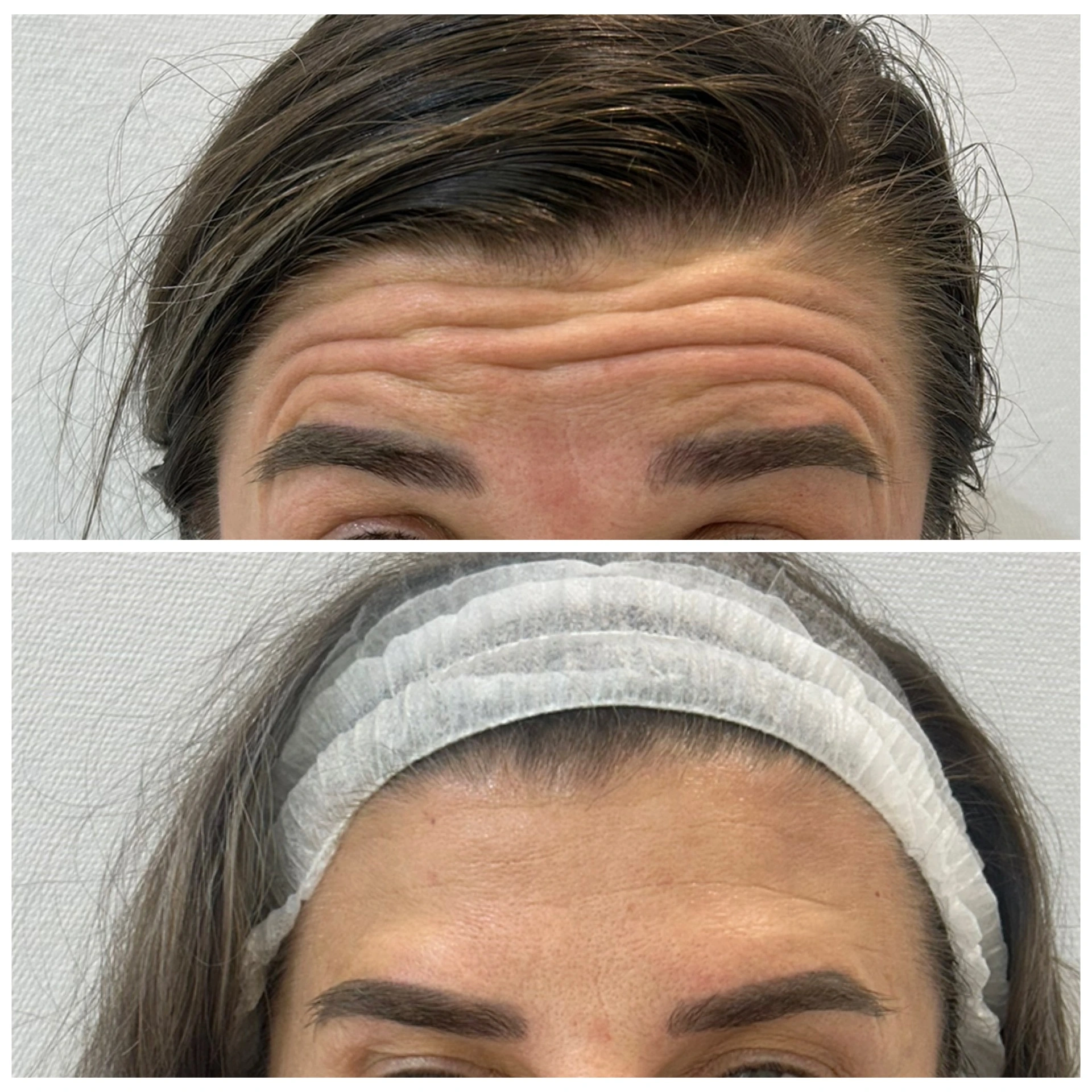
Forehead lines — before (top) and after (bottom). Treated by Dr. Azra Vaziri, Dubai.
* Photographs published with the patient’s written consent, in line with UAE medical advertising regulations. Individual results vary — book a consultation to see cases similar to yours.
Frequently Asked Questions
Book a Consultation
Discuss Botox and anti-wrinkle treatment with Dr Azra Vaziri — DHA & DOH licensed, 20+ years of experience in Dubai & Abu Dhabi.
Recommended next steps