How to Know If You Need Botox, Filler, or Something Else
Most patients don’t walk in knowing exactly what they need — they walk in knowing what bothers them. Tired-looking eyes, deeper lines, a face that doesn’t quite match how they feel.
- 20+Years' experience
- DHA · DOHLicensed
- 2Clinics
- 2004Practising since
The Real Question Isn’t “Botox or Filler”
Botox and filler are two completely different tools that fix completely different problems. Botox relaxes muscles. Filler adds volume. Choosing between them without knowing what’s causing your concern is like choosing between glasses and eye drops before you’ve had an eye test.
The better question is: what’s actually going on with my face? Once you understand whether your concern is caused by muscle movement, volume loss, skin quality, or a mix of all three, the right treatment becomes obvious. Sometimes it’s Botox. Sometimes it’s filler. Often it’s neither — or both. And sometimes the answer is a skin treatment that most patients haven’t even considered.
For a full side-by-side breakdown of how each product works, see our filler vs Botox comparison. This page focuses on something different: helping you figure out which one you actually need.
Start With What You See in the Mirror
Instead of starting with products, start with concerns. Find what you recognise below:
Lines that appear when you move your face
These are dynamic wrinkles — caused by repeated muscle movement.
Read moreShow less
They show up when you frown, squint, smile, or raise your eyebrows, and fade when your face is still.
Common areas: forehead, between the brows (frown lines), crow’s feet, bunny lines
→ This usually needs Botox
Botox relaxes the muscle causing the line. No volume is added — the line simply softens or stops forming.
Lines that are there even when your face is still
These are static wrinkles — caused by lost volume, skin thinning, or sun damage.
Read moreShow less
They’re visible all the time, not just when you move. They look like creases, folds, or hollows.
Common areas: nasolabial folds, marionette lines, under-eye hollows, temples
→ This usually needs filler
Dermal filler replaces lost volume and lifts the crease from underneath. Botox won’t help here — there’s no muscle movement to relax.
Not sure whether your lines move or stay? Ask at a consultation.
Flat, tired, or sunken-looking face
This is volume loss — the fat pads, bone, and soft tissue that give your face its shape have started to shrink or shift.
Dull, rough, or tired-looking skin
This isn’t about lines or volume
Read moreShow less
— it’s about skin quality. The texture is uneven, the glow is gone, the skin looks thin or dry. Many patients assume they need filler when the real issue is the skin itself.
Common causes: sun damage, dehydration, Dubai’s climate, natural aging
→ This usually needs skin treatments
Skin boosters, Profhilo, Dermapen, or polynucleotides — not Botox or filler.
Not sure if your concern is skin quality or volume? Ask at a consultation.
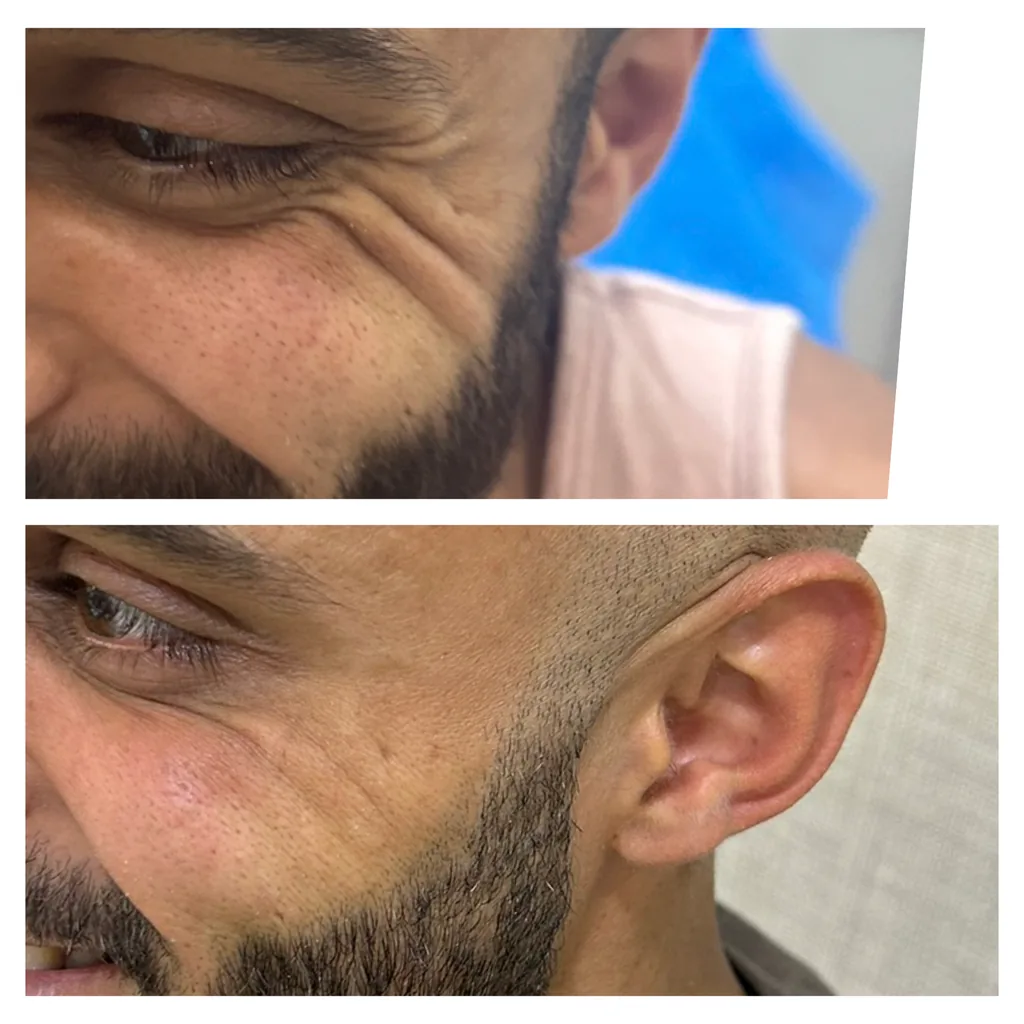
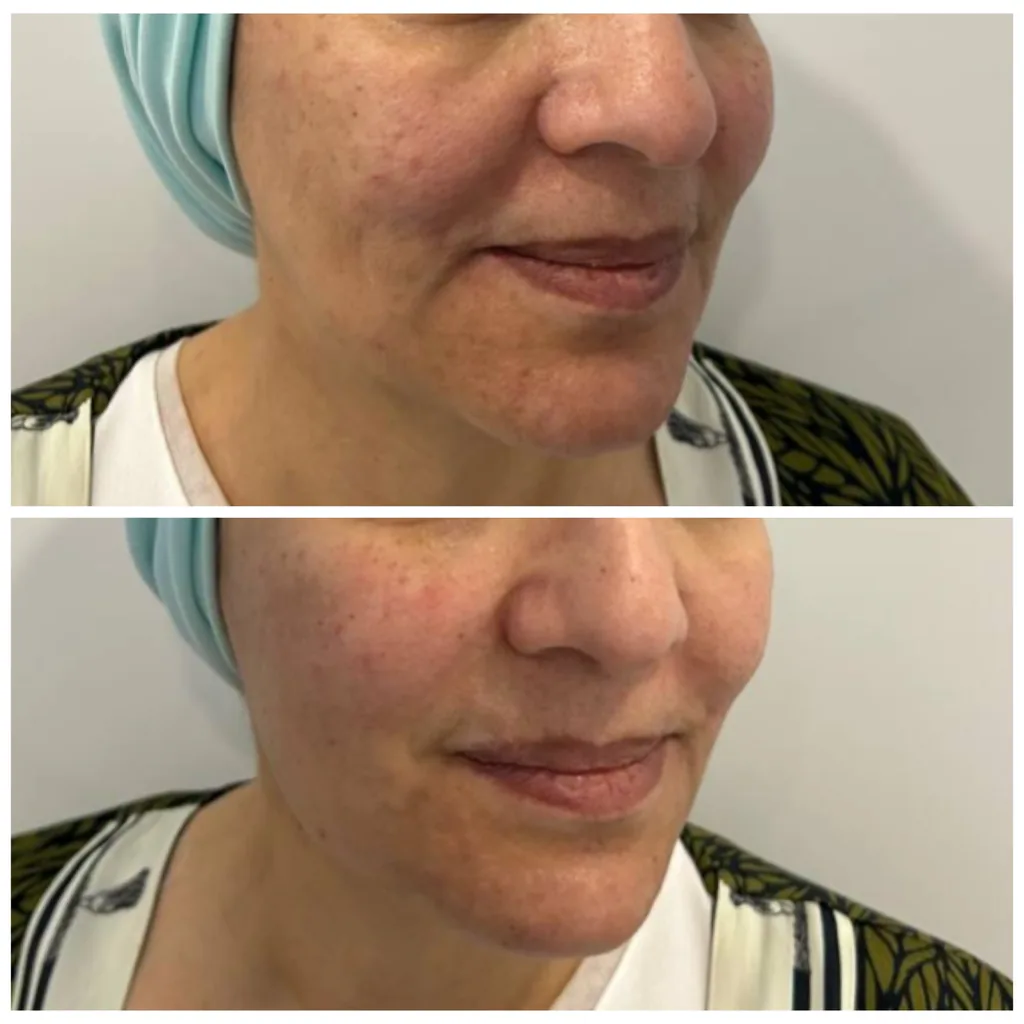
Botox and Filler Before and After
Botox relaxes a muscle: crow’s feet softened — before (top), after (bottom). Treated by Dr. Azra Vaziri, Dubai.
Filler replaces lost volume: mid-face restored — before (top), after (bottom). Treated by Dr. Azra Vaziri, Dubai.
* Photographs published with the patients’ written consent, in line with UAE medical advertising regulations. Individual results vary.
What About Both
Many patients need a mix. That’s completely normal — most faces show more than one type of aging at the same time. A woman in her 40s might have dynamic forehead lines (Botox), hollowing under the eyes (filler), and dull skin texture (skin booster). Treating only one of those won’t give her the refreshed result she’s looking for.
This is where a full face assessment matters. A doctor who looks at the whole picture — not just the one thing you point at — will build a plan that treats the actual causes, in the right order, with the right products. Sometimes that means doing less at each visit but getting a better result overall.
Botox and filler can be done in the same session. They don’t interfere with each other. But they should always be part of a plan, not a random pick from a menu.
Common Mistakes Patients Make When Choosing
Asking for filler when the problem is muscle movement. Deep frown lines between the brows look like they need filling — but they’re caused by the muscle underneath. Filler can soften them slightly, but Botox stops the muscle that creates them. Without Botox, the filler gets pushed out by the same movement that caused the line.
Asking for Botox when the problem is volume loss. Botox can’t fill a hollow cheek or lift a flat midface. If your concern is that your face looks deflated or sunken, Botox won’t help — you need volume, either from filler or a biostimulator.
Thinking filler will fix skin quality. Dull, rough, or dehydrated skin won’t look better with more volume underneath it. The skin itself needs treatment first — skin boosters, Profhilo, chemical peels, or microneedling. In Dubai’s climate especially, skin hydration and texture are often the real issue behind a tired look.
Choosing a treatment based on what a friend had. What works on one face doesn’t work on another. Skin thickness, bone structure, fat distribution, and aging patterns are different for everyone. A treatment plan should start with your face, not someone else’s result.
Quick Reference: Concern → Treatment
This is a guide, not a diagnosis. Your face may need a different approach depending on skin type, age, and what treatments you’ve had before. A proper consultation is the only way to be sure.
| What You See | Likely Treatment | What’s Causing It |
|---|---|---|
| Forehead lines when you raise your brows | Botox | Muscle movement |
| Frown lines between the brows | Botox | Muscle movement |
| Crow’s feet when you smile | Botox | Muscle movement |
| Deep lines from nose to mouth | Filler | Volume loss + gravity |
| Hollow or dark under-eyes | Filler or polynucleotides | Volume loss + thin skin |
| Flat or deflated cheeks | Filler or Sculptra | Volume loss |
| Loose skin along the jaw | Threads or filler | Skin laxity + volume loss |
| Dull, rough, or tired-looking skin | Skin boosters / Profhilo | Skin quality |
| Thin lips or lost lip shape | Lip filler or lip flip | Volume loss + aging |
Why a Consultation Matters More Than Research
Reading articles like this one is a good starting point. But there’s a limit to what you can self-diagnose. Most patients think their concern is one thing — and when an experienced doctor actually looks at their face, the real cause turns out to be something else entirely.
A patient who comes in asking for lip filler may actually need Botox around the mouth to relax the muscles pulling the lips inward. A patient asking for cheek filler may really need skin boosters to fix the dull, dehydrated texture making her cheeks look flat. A patient wanting wrinkle treatment may benefit most from a combination of Botox for the dynamic lines and a skin-quality treatment for the fine surface lines.
The right doctor won’t just give you what you ask for. They’ll tell you what you actually need — and sometimes that means less than you expected, not more.
Frequently Asked Questions
How do I know if I need Botox or filler?
It depends on what’s causing your concern. If your lines only appear when you move your face — like when you frown or smile — that’s a muscle issue and Botox is usually the right treatment. If your lines are there all the time, or you’ve lost volume in areas like the cheeks or under-eyes, filler is more likely to help. Many patients need a combination of both.
Can I get Botox and filler at the same time?
Yes. They treat different things and don’t interfere with each other. It’s common to have Botox for the upper face (forehead, frown, crow’s feet) and filler for the mid or lower face (cheeks, nasolabial folds, lips) in the same session.
What if I don't need either?
That’s possible — and a good doctor will tell you. If your concern is skin quality rather than lines or volume, treatments like skin boosters, Profhilo, Dermapen, or polynucleotides may be a better fit. Sometimes the best treatment isn’t what you came in asking for.
Is Botox or filler better for wrinkles?
It depends on the type of wrinkle. Dynamic wrinkles (caused by muscle movement) respond to Botox. Static wrinkles (caused by volume loss or sun damage) respond to filler. Deep lines that are visible all the time sometimes need both — Botox to stop the muscle from making it worse, and filler to lift the crease from underneath. See our full Botox vs filler comparison for more detail.
What age should I start Botox or filler?
There’s no fixed age. Some patients start preventative Botox in their late 20s to stop lines from setting in. Others don’t need anything until their 40s. It depends on your skin, your genetics, your lifestyle, and how your face is aging. A consultation will tell you whether you need anything yet — and what to start with if you do. See also: best filler for your age.
Will I look frozen or overdone?
Not with the right doctor and the right amount. The frozen look comes from too much Botox. The overfilled look comes from too much filler. Both are preventable with proper assessment, conservative dosing, and a doctor who prioritises natural results over volume. Dr Azra’s approach is to treat the minimum needed and build gradually.
How long do Botox and filler last?
Botox typically lasts 3–4 months, sometimes longer with regular treatment. Filler lasts 6–18 months depending on the product and area. How long fillers last varies — lip filler breaks down faster than cheek filler because of the amount of movement in the area.
How much does Botox or filler cost in Dubai?
Costs depend on the area, the amount of product, and the complexity of the treatment plan. See our Botox prices and dermal filler prices for current rates. A consultation will give you a clear quote based on what your face actually needs.
Where to go next
Read next: the treatment page, Botox in Dubai and all options in this area, Face Treatments in Dubai.
See also: Dermal Fillers.
Book a Consultation
Dr Azra Vaziri — DHA & DOH licensed aesthetic physician with 20+ years of experience in Dubai & Abu Dhabi.