TCA CROSS for Acne Scars in Dubai
TCA CROSS — Chemical Reconstruction Of Skin Scars — is a precise technique for deep, narrow acne scars, especially ice pick scars. A high-strength trichloroacetic acid is placed only into the base of each pit, triggering focused collagen formation that lifts and tightens the scar from the bottom up.
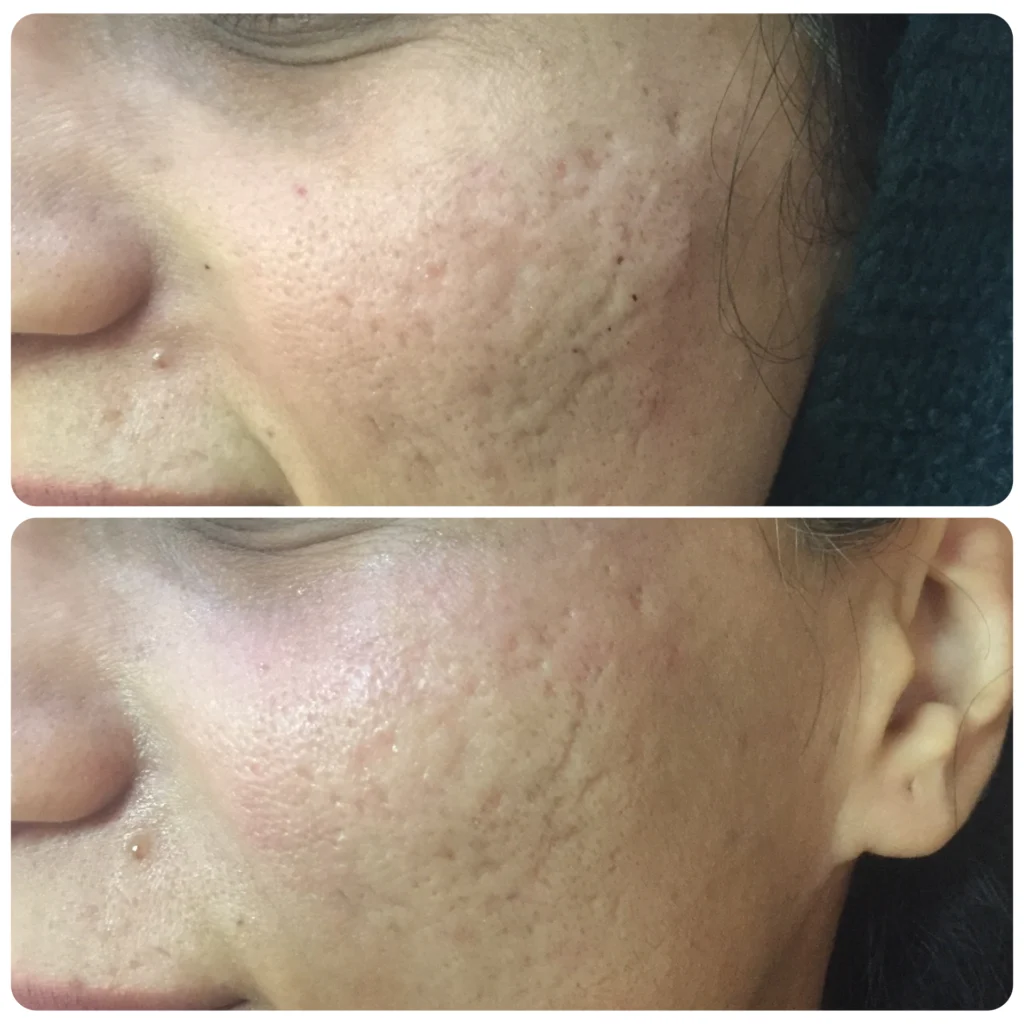
Photograph published with the patient’s written consent, in line with UAE medical advertising regulations. Individual results vary.
TCA CROSS for Acne Scars in Dubai at a glance
TCA CROSS in Dubai treats deep ice pick acne scars — high-strength acid placed into each pit to rebuild collagen from the base. By Dr Azra Vaziri.
Performed by Dr Azra Vaziri at Prof Sakla Spanish Eye Clinic, Dubai
BOOK A SCAR ASSESSMENT
How TCA CROSS Works
Using a fine applicator, a small, controlled amount of concentrated trichloroacetic acid is deposited directly into the depth of each scar. The acid causes a focal, controlled injury at the base of the pit. As the skin heals, it lays down new collagen precisely where it is needed, gradually raising the floor of the scar and narrowing its opening. Because only the inside of the scar is treated, the healthy skin around it is left intact.
A small white “frost” appears at each treated point during the session — the visible sign the acid has taken. This settles into tiny scabs that heal over about a week. Results are cumulative, so the technique is repeated over several sessions to progressively shallow each scar.
Which Scars TCA CROSS Treats
Ideal for
- Ice pick scars — the classic indication
- Narrow, deep boxcar scars with steep walls
- Individual deep pits within otherwise treatable skin
Not the right tool for
Not sure which of these describes your scars? Ask us for an assessment and each one will be mapped and matched to the right technique.
Read moreShow less
- Rolling scars — use subcision instead
- Broad, shallow depressions — better resurfaced
- Raised or keloid scars, and flat pigmentation
What to Expect
- Assessment — suitable ice pick and narrow scars are identified. Active acne is controlled first.
- Application — acid is placed precisely into each pit; a brief sting and a small white frost are normal and expected.
- Healing — tiny scabs form and shed over about a week. Sun protection is essential in the UAE to prevent pigmentation.
- Repeat & blend — the scars shallow gradually over 3–6 sessions; RF microneedling is often added to blend surrounding texture.
Results Timeline and Number of Sessions
TCA CROSS works gradually, so patience is part of the plan. In the week after each session the treated points scab and shed, and the skin looks much as it did before — the real change happens underneath. Over the following weeks the base of each scar fills in as fresh collagen forms, so the pit becomes shallower and casts less shadow. Because the effect is cumulative, most people need a course of 3 to 6 sessions spaced 4 to 8 weeks apart, with the exact number depending on how deep the scars are and how the skin heals between visits.
Ice pick scars are stubborn by nature, and the aim of TCA CROSS is to soften and shallow them rather than erase them completely. Once the collagen has rebuilt, the improvement is typically long-lasting, because it is a structural change within the scar itself; an occasional top-up session may be suggested if new scars form from later breakouts. Dr Azra Vaziri reviews your progress at each visit and adjusts the strength and spacing to how your skin responds. For a realistic idea of how many sessions your own scars are likely to need, book a scar assessment.
Downtime and Aftercare
Downtime after TCA CROSS is modest. The surrounding skin is left untouched, so most people carry on with normal life while a few pinpoint scabs heal over about a week. How you care for the skin during that week has a real effect on the final result, particularly in the strong UAE sun.
Do
- Let the tiny scabs fall away on their own and keep the area clean
- Apply a broad-spectrum SPF every day — essential to prevent pigmentation
- Use gentle, fragrance-free skincare while the skin settles
- Resume light makeup once the scabs have shed, usually after about a week
Read moreShow less
- Message us on WhatsApp if a treated point looks unusually red or is slow to heal
Avoid
Unsure whether something on this list applies to you? Check with the clinic before your next session.
- Picking or scrubbing the scabs — the main cause of marks
- Direct sun, saunas, steam rooms and hot yoga while healing
- Retinoids, acids and other strong actives for a few days around each session
Read moreShow less
- Swimming pools and heavy sweating until the points have healed
The Hand That Places the Acid — Dr Azra Vaziri
TCA CROSS is a controlled burn at the base of one scar. Placed a millimetre wide it marks healthy skin instead, which is why this is a physician technique and not a device setting.
Every TCA CROSS for Acne Scars appointment at this clinic is assessed and injected by Dr Azra Vaziri herself — a DHA- and DOH-licensed aesthetic physician with more than 20 years of experience, practising aesthetic medicine since 2004.
Training behind a focal acid
- Certified American Academy of Aesthetic Medicine (2012) — with more than twenty years of clinical practice, which on darker skin types decides whether a focal acid is used at all.
- Think-In, Anatomy & Aesthetic Treatment Workshop (2023) — anatomy and technique training behind depth control.
- Speaker — IMCAS World Congress 2024 (Paris), and Dubai Derma in 2023 and 2026
Risks and Side Effects
TCA CROSS is a safe procedure in trained hands, but because it uses a potent acid it is worth understanding what is normal and what is not. In the first few days you can expect small scabs, mild redness and sometimes a little darkening at each treated point — all of which settle as the skin heals.
The most important consideration, especially for the medium and darker skin tones common in the UAE, is post-inflammatory hyperpigmentation: temporary brown marks that can appear if the healing skin is exposed to sun, or if the acid is not placed precisely. Careful technique, a conservative strength and diligent sun protection keep this risk low. Rarely, if too much acid is used or it spreads beyond the scar, a treated point can heal a little larger or leave a mark — which is exactly why the acid is applied in tiny, controlled amounts to the base of the pit alone.
Infection is uncommon when the area is kept clean. Contact the clinic if you notice spreading redness, swelling, increasing pain, or any sign that a point is not healing as expected.
How TCA CROSS Compares with Other Scar Treatments
No single treatment suits every acne scar, and the best results usually come from matching the tool to the scar. TCA CROSS is the sharpest instrument for deep, narrow pits — the ice pick scars and steep-walled boxcar scars that resurfacing cannot reach the bottom of.
For rolling scars, where the skin is tethered down by fibrous bands, subcision is the better choice, because it releases those bands rather than remodelling a pit. Broad, shallow depressions and overall roughness respond best to resurfacing approaches such as RF microneedling, which treats the whole surface rather than individual points.
Most people have more than one type of scar, so TCA CROSS is often staged alongside one of these methods: the pits are rebuilt first, then a resurfacing step blends the surrounding texture for an even finish. During your assessment, Dr Azra Vaziri maps which scars you have and builds a matched acne scar treatment plan, drawing on the full menu rather than a single technique.
| Scar type | Best-matched treatment | Why |
|---|---|---|
| Ice pick — deep, narrow pits | TCA CROSS | Reaches the base of a pit that resurfacing cannot |
| Boxcar — steep, box-like walls | TCA CROSS (with resurfacing for the edges) | Tightens the pit walls from the inside |
| Rolling — tethered, wavy | Subcision | Releases the fibrous bands rather than remodelling a single pit |
| Broad, shallow texture | RF micro | Remodels a wider surface, not one deep scar |
Preparing for Your Session
A little preparation helps each session go smoothly and lowers the risk of pigmentation afterwards. Active breakouts are settled first, because treating through inflamed skin is less predictable. In the week or so before your appointment it helps to pause retinoids, exfoliating acids and other strong actives, and to avoid sunburn or a fresh tan, so the skin starts from a calm, even baseline. Arrive with clean skin and no makeup on the day, and let the clinic know about your medical history and any medicines or supplements you take. If you are prone to cold sores and the area sits near the lips, mention it in advance so it can be managed. Most importantly, come with realistic expectations: TCA CROSS delivers steady, cumulative improvement rather than an overnight change.
Frequently Asked Questions
What is TCA CROSS?
TCA CROSS (Chemical Reconstruction Of Skin Scars) is a technique in which a high-strength trichloroacetic acid is applied precisely into the base of deep, narrow acne scars — especially ice pick scars. It stimulates focused collagen that lifts and tightens the scar from within, while leaving the surrounding skin untouched.
Which scars is TCA CROSS best for?
It is the treatment of choice for ice pick scars and narrow, deep boxcar scars — the types too deep for resurfacing to reach. It is not used for rolling scars (which need subcision) or broad shallow depressions.
How many TCA CROSS sessions will I need?
Most patients need 3 to 6 sessions spaced 4 to 8 weeks apart. Improvement is cumulative — each session shallows the scars a little more, and the number depends on scar depth and healing response.
What is the downtime after TCA CROSS?
Each treated pit forms a tiny scab that sheds over about a week; the surrounding skin is unaffected. Most people carry on normally, with strict sun protection to avoid pigmentation while healing.
Is TCA CROSS safe for darker skin tones?
Yes, with careful technique. Because TCA is potent, strength and spacing are adjusted for higher Fitzpatrick skin types, and rigorous sun protection is essential to prevent post-inflammatory pigmentation. Dr Azra Vaziri tailors the protocol to your skin.
Book a Consultation
Dr Azra Vaziri — DHA & DOH licensed aesthetic physician with 20+ years of experience in Dubai & Abu Dhabi.