Boxcar Scars: What They Are and How They’re Treated in Dubai
Boxcar scars are round or oval depressions with steep, sharply defined walls — like small craters pressed into the skin. They form when inflammatory acne destroys collagen and the skin heals with a flat-bottomed, vertical-sided pit, most often on the cheeks and temples.
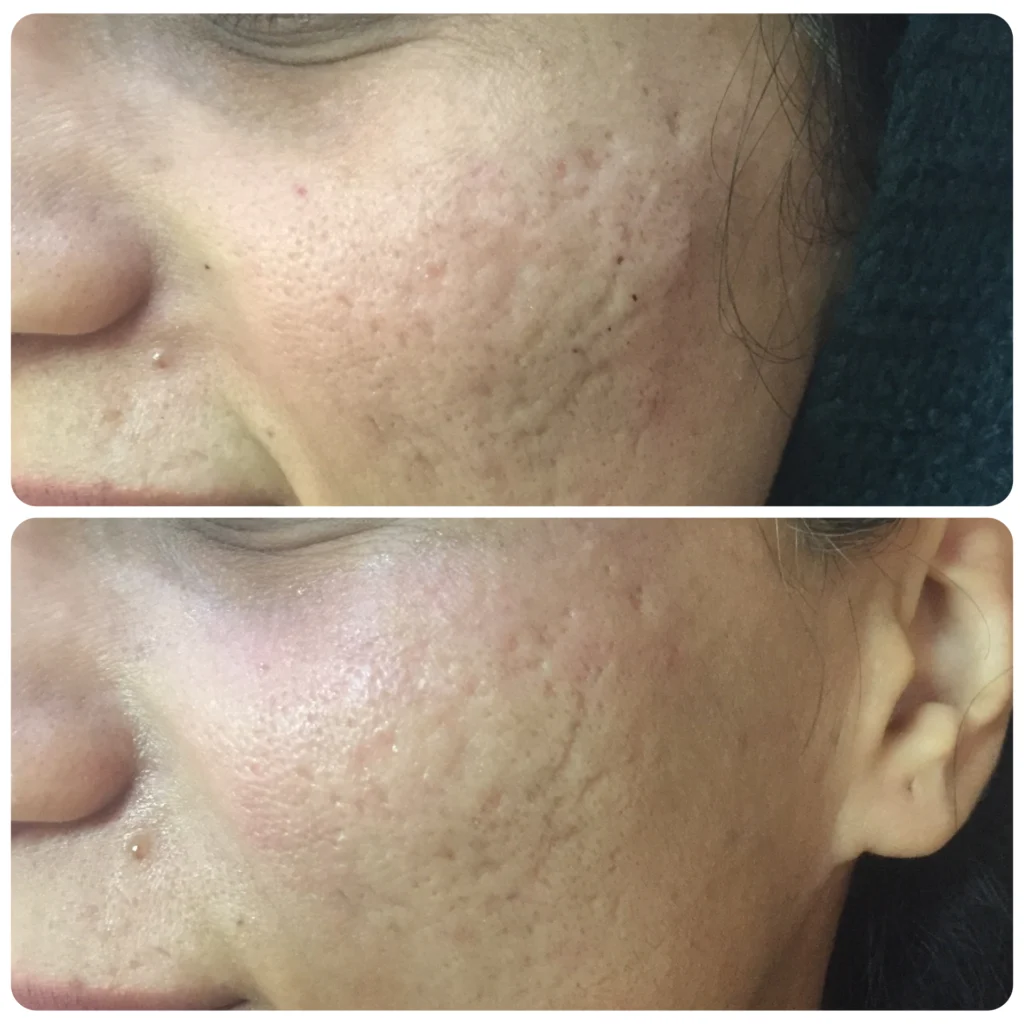
Photograph published with the patient’s written consent, in line with UAE medical advertising regulations. Individual results vary.
Boxcar Scars: What They Are and How They’re Treated in Dubai at a glance
Boxcar scars are round acne craters with steep walls and a flat base. How they differ from rolling and ice pick scars, and how Dr Azra treats them in Dubai.
- RF microneedling
- Moderate to deep boxcars, all skin types
- Microneedling peels
- Shallow boxcars and surface texture
- Subcision
- Boxcars with a tethered, bound-down base
- TCA CROSS
- Narrow, deep pits ice pick and some very deep boxcars
Performed by Dr Azra Vaziri at Prof Sakla Spanish Eye Clinic, Dubai
BOOK A SCAR ASSESSMENT
What Are Boxcar Scars?
Boxcar scars get their name from their shape: a broad, flat base with steep, near-vertical walls, like the outline of a boxcar rail wagon. They range from shallow (under about 0.5 mm) to deep, and depth is the single biggest factor in choosing treatment — shallow boxcars resurface readily, while deep ones need energy that reaches the full height of the wall.
How to recognise them: unlike rolling scars, boxcar edges are sharp and do not slope; unlike narrow ice pick scars, the opening is wide relative to its depth. Stretching the skin does not flatten a true boxcar scar, because the tissue is genuinely lost rather than tethered.
Best Treatments for Boxcar Scars
Boxcar scars need collagen rebuilt within the crater walls. Energy-based remodelling leads, with resurfacing and — for tethered or very deep scars — release or elevation added as needed.
RF Microneedling ( Potenza )
First-lineInsulated needles deliver radiofrequency energy to the full depth of the boxcar wall, driving collagen remodelling that softens the edges and lifts the base.
Read moreShow less
The most reliable treatment for moderate to deep boxcar scars, and safe for all skin types.
Sessions: 3–4, spaced 4–6 weeks apart — the exact number is confirmed at your scar assessment.
Microneedling & Resurfacing
For shallow boxcarsShallow boxcar scars respond well to Dermapen microneedling and medical peels, which resurface the top layers and smooth the wall edges over a course.
Read moreShow less
Often combined with exosomes for faster recovery.
Sessions: 4–6, spaced 3–4 weeks apart — ask at your assessment whether your boxcars are shallow enough for this route.
Subcision
If tetheredSome boxcar scars have a bound-down base.
Read moreShow less
Where the base is tethered, subcision releases it first so the RF microneedling that follows can lift and remodel the crater more completely.
Role: release a tethered base before remodelling — tethering is checked by hand at your scar assessment.
Biostimulators & Boosters
SupportCollagen biostimulators and skin boosters improve overall skin density and quality between resurfacing sessions, helping the treated area hold its result.
Read moreShow less
Role: skin quality and long-term support — discuss these alongside your resurfacing plan.
What to Expect
- Grading — boxcar depth is assessed, since shallow and deep scars follow different plans. Active acne is controlled first.
- Energy-led plan — RF microneedling leads for moderate–deep scars; microneedling and peels handle shallow ones; subcision is added if the base is tethered.
- Recovery — 2–5 days of redness after RF microneedling; 1–3 days for lighter work. Sun protection is essential in the UAE.
- Progressive result — walls soften and the base lifts gradually over 3–4 sessions as collagen remodels across several months.
Matching the Treatment to Your Boxcar Scars
No single method suits every boxcar scar. Depth, whether the base is tethered, and your skin type decide the plan.
Most patients do best with a staged combination rather than one treatment on its own. Dr Azra Vaziri matches each option to the scar in front of her at your scar assessment. Because the plan is staged, what you pay depends on which treatments it uses and how many sessions your scarring needs — see acne scar treatment cost in Dubai.
| Treatment | Best for | Why it works |
|---|---|---|
| RF microneedling | Moderate to deep boxcars, all skin types | Insulated needles remodel collagen to the full depth of the wall — the first-line workhorse |
| Microneedling & peels | Shallow boxcars and surface texture | Resurface the top layers and smooth the wall edges over a course |
| Subcision | Boxcars with a tethered, bound-down base | Releases the base first so remodelling can lift the crater more completely |
| TCA CROSS | Narrow, deep pits — ice pick and some very deep boxcars | Focused acid rebuilds collagen inside a tight scar; usually paired with resurfacing |
| Biostimulators & boosters | Overall skin density between sessions | Support skin quality so the treated area holds its result |
Boxcar Scars vs Other Acne Scar Types
Acne leaves several different scar shapes, and they do not all respond to the same treatment — which is exactly why grading comes before any plan. Most faces show a mix, so telling them apart is the first thing Dr Azra does at a scar assessment.
Boxcar
A broad opening with steep, near-vertical walls and a flat base. It does not flatten when the skin is stretched. Energy resurfacing that rebuilds the wall — led by RF microneedling — is the mainstay.
Rolling
Wide and shallow with soft, sloping edges, caused by fibrous bands tethering the skin from below. Subcision to release the bands is the key step, often with RF microneedling.
Ice pick
Narrow and deep, like a fine puncture. Too tight for broad resurfacing to reach the base, so these usually need focal TCA CROSS rather than the boxcar approach.
Why a Combination Usually Wins
Boxcar scars rarely have a single cause of depth: the wall needs collagen, a tethered base needs releasing, and the surrounding skin needs to resurface evenly. One tool rarely does all three, so Dr Azra Vaziri stages treatments across a course — for example subcision to free a bound base, RF microneedling to rebuild the wall, and a peel or microneedling pass to refine the surface. Staging also lets the skin recover between sessions, which protects darker skin tones from pigmentation and lets each result settle before the next step is chosen.
Are You a Good Candidate?
Who does well
Adults with settled boxcar scarring whose active acne is under control. Shallow and moderate boxcars respond most predictably; deep, wide craters still improve but usually need more sessions and a combination approach.
What shapes the plan
Scar depth, whether the base is tethered, your Fitzpatrick skin type and how your skin heals. Darker skin tones are treated with insulated RF microneedling and carefully selected peels to protect against pigmentation.
Discussed at assessment
Recent isotretinoin (Roaccutane) use, any tendency to pigment or scar, your current skincare and realistic goals. Active breakouts are settled before resurfacing begins, so the result is not undone by fresh acne. Bring your current skincare and any recent prescriptions to your assessment.
Aftercare and Getting the Best Result
Boxcar-scar treatment rebuilds collagen gradually, so how you look after the skin between sessions has a real effect on the final result. The essentials are simple, and they matter most in Dubai’s strong sun.
- Sun protection is non-negotiable. Daily broad-spectrum SPF for the weeks after each session — healing skin and fresh collagen pigment easily in the UAE climate.
- Keep skincare simple for a few days. A gentle cleanser and moisturiser only; pause retinoids, acids and scrubs until the redness settles.
- Do not pick or exfoliate the area. Let any micro-crusting shed on its own so the new collagen forms cleanly.
- Keep to the spacing. RF microneedling sessions sit 4 to 6 weeks apart so collagen has time to remodel before the next pass — rushing it does not speed the result.
- Judge the result at the finish, not mid-course. Walls soften and the base lifts over months; the full effect of a course is best assessed around three months after the last session, which is when Dr Azra books your review.
Who Matches the Treatment to the Scar — Dr Azra Vaziri
Boxcar scars have a floor and a wall, and which of the two you treat decides the result. That reading is made before any device is switched on.
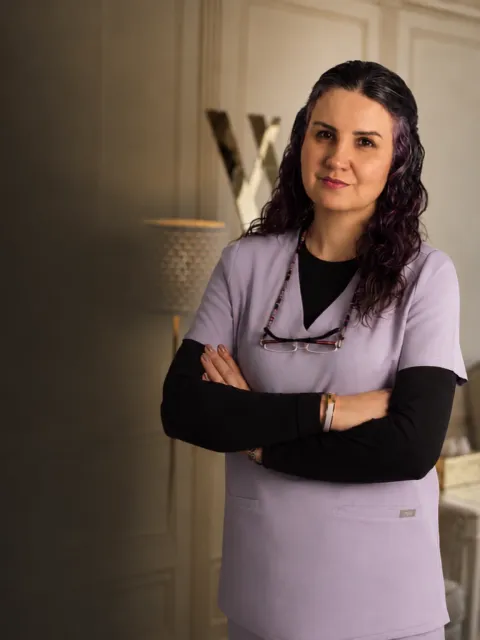
Every Boxcar Scars: What They Are and How They’re Treated appointment at this clinic is assessed and injected by Dr Azra Vaziri herself — a DHA- and DOH-licensed aesthetic physician with more than 20 years of experience, practising aesthetic medicine since 2004.
Training behind the reading
- Think-In, Anatomy & Aesthetic Treatment Workshop (2023) — facial anatomy training, which is what resurfacing depth and subcision both depend on.
- Aptos Threads International Certified Trainer
- Speaker — IMCAS World Congress 2024 (Paris), and Dubai Derma in 2023 and 2026
Frequently Asked Questions
What are boxcar acne scars?
Boxcar scars are round or oval depressions with steep, well-defined walls and a flat base, most common on the cheeks and temples. They form when inflammatory acne destroys collagen and the skin heals with a sharp-sided pit. Depth ranges from shallow to deep, which guides treatment.
What is the best treatment for boxcar scars?
RF microneedling (Dr Azra uses the Potenza platform) is the first-line treatment for moderate to deep boxcar scars because it remodels collagen to the full depth of the wall. Shallow boxcars also respond to microneedling and medical peels.
How are boxcar scars different from ice pick scars?
Boxcar scars are wide relative to their depth, with steep walls and a flat base. Ice pick scars are narrow and deep, like a puncture. Because of this, boxcars respond to energy resurfacing while ice pick scars usually need TCA CROSS.
Can boxcar scars be removed completely?
Boxcar scars can be significantly improved, with walls softened and the base lifted over a course of treatment. Complete removal is uncommon, but a marked, natural improvement is a realistic goal — especially for shallow and moderate scars.
How many sessions do boxcar scars need?
Most boxcar plans involve 3 to 4 RF microneedling sessions spaced 4 to 6 weeks apart, sometimes with added microneedling or peels for surface refinement. Improvement builds progressively over several months as collagen remodels.
Is boxcar scar treatment safe for darker skin?
Yes. RF microneedling uses insulated needles that bypass the surface, making it safe for all Fitzpatrick skin types. Resurfacing peels are selected carefully for higher skin tones to avoid pigmentation. Dr Azra Vaziri matches every plan to your skin type.
Book a Consultation
Dr Azra Vaziri — DHA & DOH licensed aesthetic physician with 20+ years of experience in Dubai & Abu Dhabi.