Acne Scar Treatment · Dubai
Ice Pick Scars: What They Are and How They’re Treated in Dubai
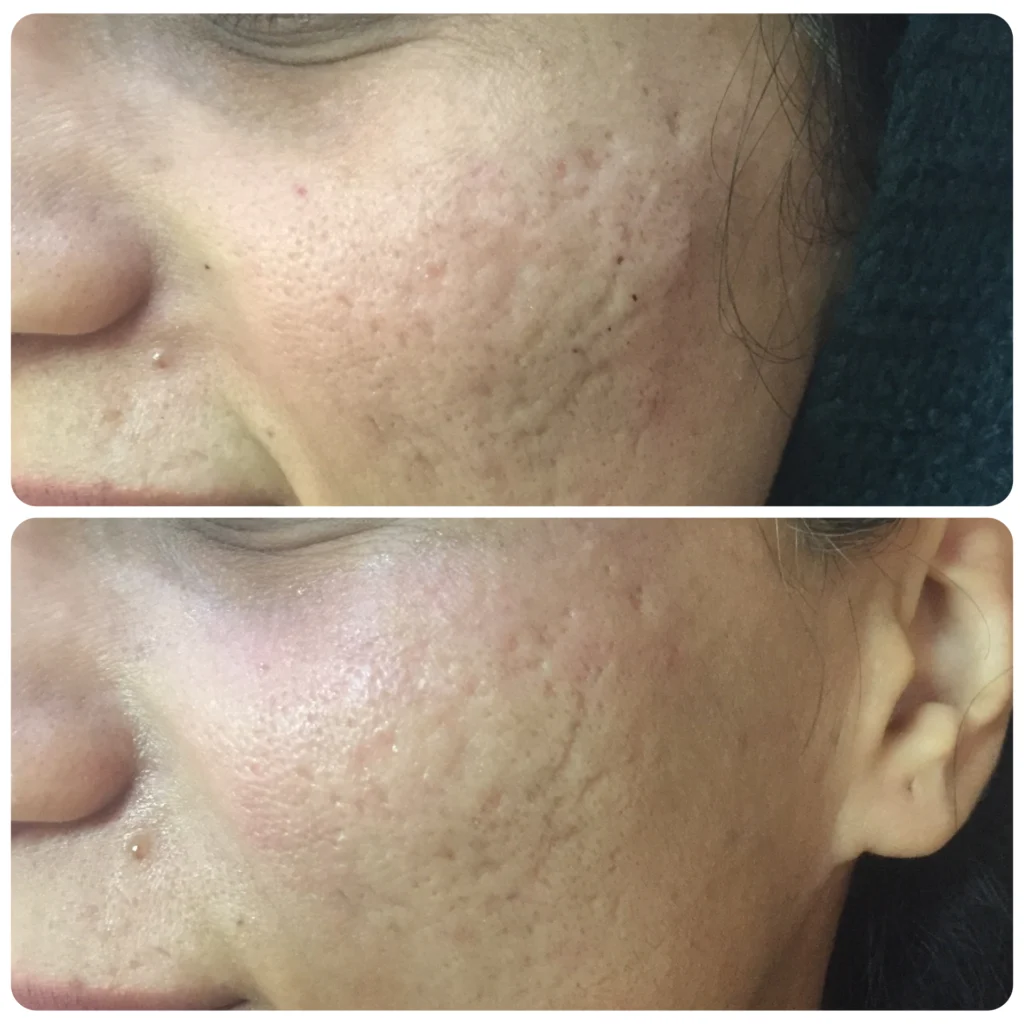
Ice pick scars are the narrow, deep, V-shaped pits that look as though the skin was punctured with a fine point. They are the most challenging acne scar to treat, because they are deeper than they are wide — surface resurfacing simply cannot reach the bottom of the channel.
- 3–6Sessions
- 4–8 wkApart
- ~1 wkHealing
Photograph published with the patient’s written consent, in line with UAE medical advertising regulations. Individual results vary.
Ice Pick Scars: What They Are and How They’re Treated in Dubai at a glance
Ice pick scars are narrow, deep, V-shaped acne pits. Why surface treatments cannot reach them, and how Dr Azra treats them with TCA CROSS in Dubai.
- Sessions
- 3–6
- Apart
- 4–8 wk
- Healing
- ~1 wk
Performed by Dr Azra Vaziri at Prof Sakla Spanish Eye Clinic, Dubai
What Are Ice Pick Scars?
Ice pick scars form when deep, inflamed acne (often cysts) destroys tissue in a narrow column, leaving a fine channel that tapers to a point in the dermis. Their defining feature is that they are deeper than they are wide — often less than 2 mm across at the surface but extending well below. This geometry is why treatments that resurface the top of the skin have little effect: the base of the scar sits far beneath the reach of standard microneedling or peels.
How to recognise them: small, sharp, deep pits that look like enlarged, angular pores; most common on the cheeks. Distinguishing them from narrow boxcar scars matters, because ice pick scars need a technique that works inside the channel rather than across the surface.
Best Treatments for Ice Pick Scars
Ice pick scars need collagen rebuilt from deep within the channel. The techniques below work at that depth, and are usually combined with a resurfacing step to blend the result.
Tca cross
First-lineA high-strength trichloroacetic acid is applied precisely into the base of each pit (CROSS = Chemical Reconstruction Of Skin Scars).
DetailsShow less
It triggers focused collagen formation that shallows and tightens the channel over repeated sessions. The most targeted option for ice pick scars.
Sessions: typically 3–6, spaced 4–8 weeks apart
Punch Techniques
For very deep pitsFor the deepest or widest-mouthed ice pick scars, a tiny punch can remove or elevate the scar so it heals as a flatter, more treatable surface.
DetailsShow less
Used selectively on individual scars that will not respond to TCA CROSS alone.
Role: reserved for the deepest individual scars — whether any of yours qualify is decided at your scar assessment.
RF Microneedling
To blendAfter the pits are shallowed with TCA CROSS, RF microneedling improves the surrounding texture and overall collagen, blending the treated scars into smoother skin.
DetailsShow less
Role: texture blending after focal treatment — the sequencing is planned at your consultation.
Why Not Subcision?
Not suitableSubcision works on tethered depressions like rolling scars
Read moreShow less
— not on narrow ice pick channels, which are not tethered. Knowing this avoids the wrong treatment and wasted sessions.
Better for: rolling & tethered boxcar scars — your own scar mix is confirmed at the assessment.
What to Expect
- Per-scar assessment — each ice pick scar is judged individually; TCA CROSS suits most, punch techniques a few. Active acne is controlled first.
- Focal treatment — TCA CROSS is applied precisely into each pit. You may notice a brief sting and a small white frost that fades over days.
- Recovery — tiny scabs form at each treated point and heal over about a week. Strict sun protection is essential, especially in the UAE, to avoid pigmentation.
- Patience pays — ice pick scars improve gradually across several sessions. They are the slowest scar type to respond, but steady tightening is achievable.
Matching the Scar to the Treatment
Acne scarring is rarely one type. Choosing the right technique starts with reading the shape of each scar — because what shallows an ice pick pit is not what releases a tethered depression. The table below shows how the main atrophic scar types differ and which approach suits each.
Most people carry a mix of these, so a real plan usually combines a focal method for the ice pick pits with a resurfacing step for the surrounding skin. That is why assessment comes first — each scar is matched to the method that actually reaches it.
| Scar type | Shape at the surface | Best-matched approach |
|---|---|---|
| Ice pick (this page) | Narrow, deep, V-shaped pits — deeper than they are wide | TCA CROSS first-line; a punch technique for the deepest few |
| Boxcar | Broad depressions with sharp, defined edges | RF microneedling; subcision when the base is tethered |
| Rolling | Broad, sloping, wave-like dips caused by tethering below | Subcision to release, then RF microneedling to remodel |
Are You a Candidate for TCA CROSS?
TCA CROSS suits the great majority of true ice pick scars, but timing and skin condition matter. A short assessment decides whether to treat now or prepare the skin first.
Good candidate
- Defined, narrow ice pick pits, most often on the cheeks
- Active acne is settled or well controlled
- Ready to commit to a course spaced several weeks apart
- Realistic goal of tightening and blending rather than erasing
Plan first
If any of these apply to you, say so when you book your assessment, so strength, spacing and timing can be adjusted before the first session.
- Active or inflamed breakouts — these are calmed before treating scars
- A history of pigmentation or very reactive skin — strength and spacing are adjusted
DetailsShow less
- Recent oral acne medication — flag it so timing can be reviewed
- A tendency to raised or keloid scarring — assessed individually first
Results Timeline
Ice pick scars are the slowest scar type to respond, so improvement is measured across the course rather than after a single visit. A typical journey looks like this:
Progress is reviewed at every visit and the spacing adjusted to how your skin responds. To find out how many sessions your own scar depth is likely to need, book a scar assessment.
- First week after each session — a tiny scab forms at every treated point and heals over roughly seven days. The skin looks worse before it looks better; this is expected.
- Between sessions (4–8 weeks) — new collagen builds at the base of each pit, so the channel begins to shallow. Sessions are spaced to let this remodelling happen before the next round.
- Across the course (3–6 sessions) — the cumulative effect is what counts. Pits tighten, edges soften, and the scars stop catching the light as sharply.
- Months after the last session — collagen continues to mature, so the final result is judged some weeks later, often alongside a resurfacing step to blend the surrounding skin.
Risks, Downtime & Aftercare
TCA CROSS is a focal treatment, so downtime is limited to the treated points rather than the whole face. During a session you may feel a brief sting as the acid is applied, and a small white frost appears and fades over the following days. Tiny scabs then form at each point and heal within about a week.
The main risk to manage is post-inflammatory pigmentation — temporary darkening where the skin was treated. This matters especially under strong UAE sun and on deeper skin tones, which is why disciplined sun protection is non-negotiable through the course. Less commonly, disturbing a scab too early can slow healing.
Aftercare that protects the result: let every scab shed on its own — never pick; apply a high-factor sunscreen daily and reapply outdoors; keep the routine gentle and pause strong actives such as retinoids and exfoliating acids until the skin has settled; and follow the spacing given so collagen has time to build between sessions. Clear, written aftercare is provided at each visit, and if anything looks unexpected while you are healing, contact the clinic rather than waiting for your next appointment.
Who Performs TCA CROSS on Your Skin — Dr Azra Vaziri
TCA CROSS puts a high-strength acid into the base of a scar and nowhere else; a drop in the wrong place makes a new mark on healthy skin.
Every Ice Pick Scars: What They Are and How They’re Treated appointment at this clinic is assessed and injected by Dr Azra Vaziri herself — a DHA- and DOH-licensed aesthetic physician with more than 20 years of experience, practising aesthetic medicine since 2004.
Training behind a precision technique
- Certified American Academy of Aesthetic Medicine (2012) — with more than twenty years of clinical practice, which on darker skin types is what decides whether a focal acid is used at all.
- Aptos Threads International Certified Trainer
- Speaker — IMCAS World Congress 2024 (Paris), and Dubai Derma in 2023 and 2026
Frequently Asked Questions
What are ice pick acne scars?
Ice pick scars are narrow, deep, V-shaped pits that look like the skin was punctured with a fine point. They are deeper than they are wide, which is why surface resurfacing cannot reach their base and why they are the most challenging acne scar type to treat.
What is the best treatment for ice pick scars?
The most targeted treatment is TCA CROSS, in which high-strength acid is applied precisely into each pit to rebuild collagen from the base and shallow the scar over several sessions. Very deep individual scars may instead need a punch technique.
Why don't microneedling or subcision work on ice pick scars?
Standard microneedling and peels resurface the top of the skin, but ice pick scars extend far deeper than these reach. Subcision releases tethered scars such as rolling scars, but ice pick channels are not tethered, so subcision does not help them.
Can ice pick scars be removed completely?
Ice pick scars can be made significantly shallower and less noticeable with TCA CROSS over a course, but complete removal is uncommon because of their depth. A realistic goal is meaningful tightening and blending so they no longer catch the light.
How many TCA CROSS sessions are needed?
Most ice pick scars need 3 to 6 TCA CROSS sessions spaced 4 to 8 weeks apart, with improvement building gradually. The exact number depends on scar depth and how the skin responds between sessions.
Is TCA CROSS safe for darker skin?
TCA CROSS can be performed on darker skin, but because the acid is potent, careful technique and strict sun protection are essential to avoid post-inflammatory pigmentation. Dr Azra Vaziri adjusts strength and spacing for higher Fitzpatrick skin types.
Book a Consultation
Dr Azra Vaziri — DHA & DOH licensed aesthetic physician with 20+ years of experience in Dubai & Abu Dhabi.