
Comparison Guide · Morpheus8 · HIFU
Morpheus8 vs HIFU: Which Tightening Treatment?
Morpheus8 combines radiofrequency energy with microneedling — needles penetrate the skin and deliver RF heat at precise depths to remodel collagen and tighten from within. HIFU (High-Intensity Focused Ultrasound) delivers focused ultrasound energy deep into tissue without breaking the skin surface — targeting the SMAS layer to lift and tighten.
In simple terms: Morpheus8 = RF + microneedling (treats skin texture + tightening, adjustable depth, some downtime). HIFU = focused ultrasound (deeper lift targeting the SMAS layer, no skin surface disruption, minimal downtime). Morpheus8 is better for texture + tightening; HIFU is better for pure lifting.
One thing to be clear about. Morpheus8 is InMode’s brand of RF microneedling. It is one device among several — Potenza, Secret RF, Sylfirm X and others do the same job. Dr Azra Vaziri treats on the Potenza platform by Cynosure, so when this guide says “Morpheus8” it is describing the RF microneedling category that Morpheus8 made famous. HIFU is a different modality altogether, and the clinic offers that too.
Both are non-surgical alternatives to a facelift. This guide explains how Dr Azra Vaziri decides between them. Related: Saggy Skin Treatment · Skin Tightening Treatment · Non-Surgical Facelift Options · Collagen Stimulation Treatments.
Side-by-Side Comparison
When to Choose Each Treatment
- Primary concern is texture + tightening combined
- You want to treat acne scars or enlarged pores
- You want to combine with exosomes or PRP
- You can tolerate 2–5 days of downtime
- You want adjustable depth for different zones (vs standard Dermapen microneedling)
- Primary concern is lifting and skin laxity
- You want a non-surgical facelift or thread lift effect
- You need minimal downtime (hours, not days)
- You want to treat the SMAS layer (deepest)
- You want fewer sessions (1–2 vs 3–4)
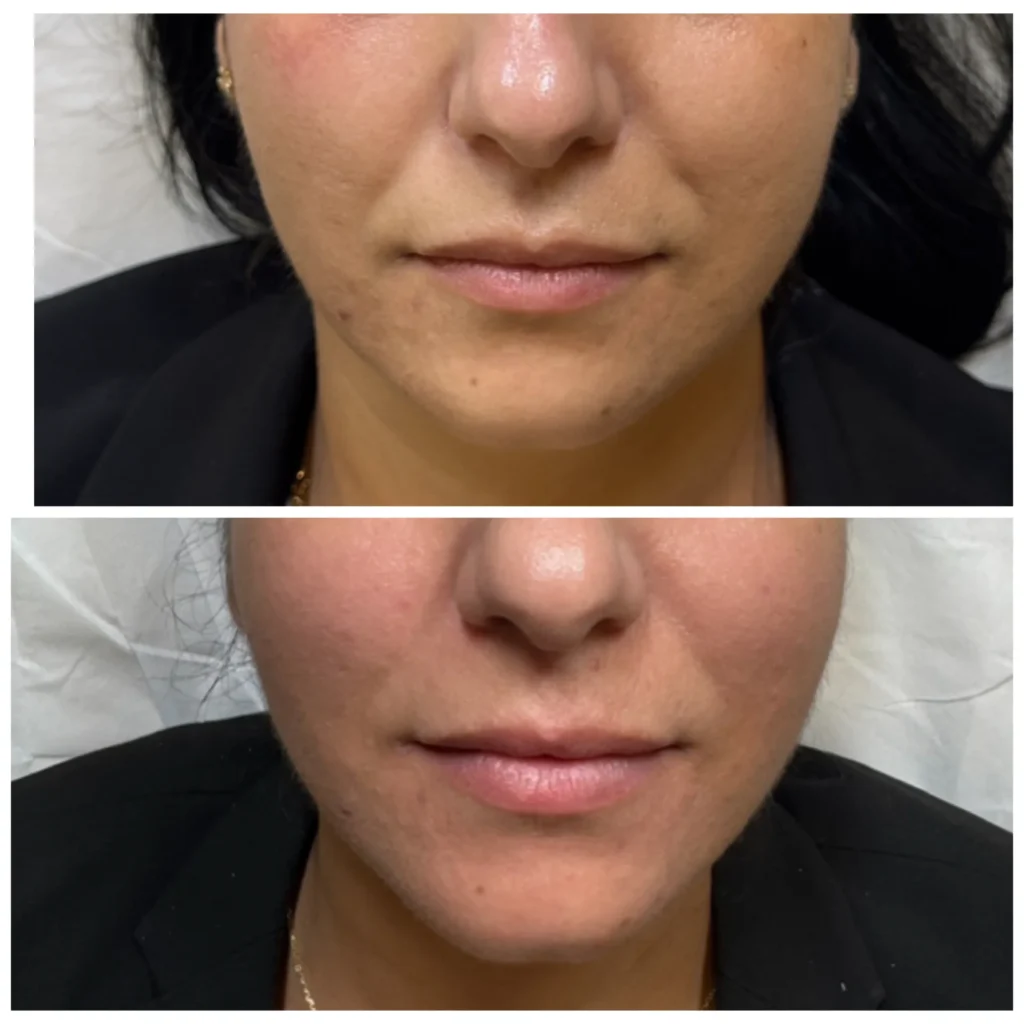
The RF microneedling side of the comparison. Texture and firmness together — the improvement ultrasound alone does not produce. Treated on the Potenza platform by Dr. Azra Vaziri, Dubai.
* Published with the patient’s written consent, in line with UAE medical advertising regulations. Individual results vary.
How Each One Actually Feels
The comparison tables rarely say what the hour in the chair is like, and for most people that is the deciding factor.
RF microneedling
Topical anaesthetic for 30–45 minutes first. The sensation is pressure and heat with each pass rather than a sharp needle — most patients describe it as tolerable but not comfortable. Session takes 30–60 minutes. You leave red and warm, like moderate sunburn, and that settles over two to five days.
HIFU
Usually no numbing cream, because the energy is delivered in short bursts rather than continuously. Each pulse is a brief deep ache or prickle at the point where the ultrasound focuses — sharper than RF but over in a second. A full face and neck takes 45–90 minutes. You walk out looking normal.
The trade-off
RF microneedling costs you a few days of looking treated and gives you texture improvement the ultrasound cannot. HIFU costs you a less comfortable hour and gives you depth the needles cannot reach. Neither is the “easier” option; they are uncomfortable in different currencies.
Both Are Safe on Deeper Skin Tones — and That Matters Here
In a city where most patients are Fitzpatrick III to VI, this is often the question that rules a treatment in or out. Ablative and pigment-targeting lasers carry a real risk of post-inflammatory hyperpigmentation on deeper skin. Neither of these does, and the reason is worth understanding.
Why RF is colour-blind
Radiofrequency heats tissue by electrical resistance, not by being absorbed into a pigment. Melanin is invisible to it. That is why RF microneedling can be used at full settings on skin that would not tolerate an ablative laser.
Why HIFU is too
Focused ultrasound is mechanical and thermal energy converging at a depth below the epidermis. It passes through the surface without depositing energy there, so the pigment-producing layer is not provoked.
What still applies
Neither being melanin-safe means either is risk-free. Aggressive settings, poor technique or treating actively inflamed skin can still cause post-inflammatory pigmentation in any skin type. The device removes one risk; the operator decides the rest.
Using Both — and Why the Order Matters
They are not rivals so much as different floors of the same building. HIFU works on the SMAS, the fibrous layer surgeons lift in a facelift; RF microneedling works in the dermis, where texture and scarring live. A plan that addresses only one leaves the other untouched.
Deep first, then surface
The usual sequence is HIFU for the structural lift, then RF microneedling four to six weeks later for the skin itself. Doing it the other way round means treating freshly needled skin with focused ultrasound, which is neither comfortable nor sensible.
Not in the same session
Both work by controlled thermal injury. Stacking them on the same day multiplies the inflammatory load without multiplying the result — and makes it impossible to tell which one caused a reaction if something goes wrong.
What a combined plan looks like
One or two HIFU sessions, then a course of three to four RF microneedling sessions spaced four to six weeks apart, then a review at six months when both have finished remodelling. Collagen is slow; the plan has to be too.
When Neither Is the Answer
An honest comparison has to include the cases where the correct answer is “something else”.
The laxity is past them
Both are energy treatments that tighten what is there. Once there is genuine excess skin and a heavy jowl, neither will produce the result the photographs promise, and a surgical consultation is the honest answer. See where non-surgical options stop.
The problem is volume, not sagging
A face that has deflated looks tired for a completely different reason. Tightening a deflated face can make it look more drawn, not younger. Volume loss and sagging are not the same thing, and the treatments are not interchangeable.
Contraindications
Pregnancy and breastfeeding, active skin infection or inflamed acne in the treatment area, a pacemaker or implanted electronic device (RF), metal implants in the treatment field, keloid tendency, and recent isotretinoin. See treatments during pregnancy and breastfeeding.
Skin quality is the real complaint
If the concern is dullness, dehydration or fine crepiness rather than laxity, a skin booster or exosome therapy will do more, for less downtime, than either energy device.
Related Treatments & Comparisons
Frequently Asked Questions
Recommended next steps
Book a Consultation
Dr Azra Vaziri — DHA & DOH licensed aesthetic physician with 20+ years of experience in Dubai & Abu Dhabi.