
Regenerative Aesthetics › Rejuran › Before & After
Rejuran Before and After — What Salmon DNA Actually Changes, and When
Salmon DNA before-and-after photos are easy to find online and hard to read honestly — lighting, angle and a fresh coat of make-up move a face more than one session of PDRN does. This page sets out what Rejuran actually changes, week by week, what it does not change at all, and how to judge your own result rather than someone else’s photo. Written by Dr Azra Vaziri, who performs every Rejuran session personally in Dubai and Abu Dhabi.
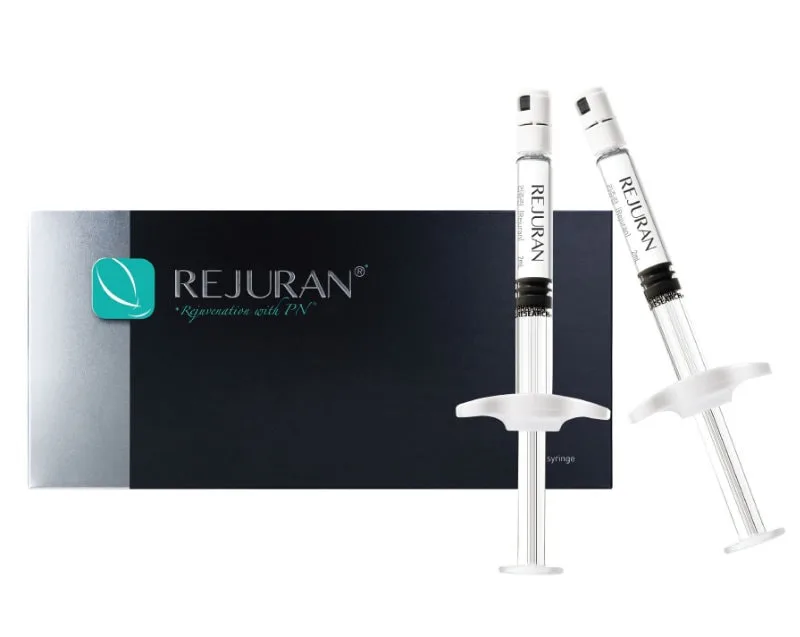
When do you see Rejuran before-and-after results? Nothing visible in week one — the small injection bumps settle in 24–48 hours and the skin often looks slightly worse before it looks better. The first real change is at 4–6 weeks after the first session: better light reflection and a smoother surface. The photographable difference — texture, fine crepiness, shallow scarring — arrives after the third or fourth session, at roughly 3 months. Rejuran improves skin quality; it does not lift, fill or contour.
The Rejuran Results Timeline, Week by Week
PDRN works on the repair pathway rather than adding volume or water, so the change accumulates instead of appearing. This is what patients actually report, and the reason a two-week photo is not a result.
What Changes — and What Does Not
Rejuran does change
Skin texture and pore appearance. Fine crepiness, especially under the eyes. Shallow rolling post-acne scarring. Persistent redness and reactivity. Dullness in skin that has taken years of sun and air conditioning. Barrier quality — skin that stops feeling tight by mid-afternoon.
Rejuran does not change
Volume. It is not a filler — hollow cheeks, a flat chin and deep folds are unchanged. Tissue that has descended: a heavy jawline or jowls needs a thread lift or RF microneedling. Deep ice-pick scars. Pigmentation, which needs its own protocol. Under-eye hollowing caused by lost fat rather than thin skin.
This is the single biggest reason a before-and-after disappoints: the patient was treating the wrong problem. If the mirror complaint is a shadow or a sag, no amount of PDRN will photograph well. If the complaint is the surface of the skin itself, it will.
Realistic Results by Concern
Under-eyes and dark circles
The most requested indication, and the one where a before/after is most visible — but only when the darkness comes from thin, crepey skin rather than hollowing. Expect thicker-looking skin and less crepe by month two, using the lower-viscosity Rejuran I formulation. If the circle is a shadow cast by a hollow, read dark circles vs hollow eyes first — a tear-trough filler is the honest answer there.
Post-acne scarring
Shallow rolling scars soften over a full course; sharp ice-pick scars do not. The strongest results come from combining PDRN with Dermapen microneedling so the product reaches the scarred layer directly. Judge this one at month three, not month one.
Texture, pores and dullness
The most reliable before/after of the three, and the least dramatic in a photograph — it reads as skin that catches light evenly rather than as a changed face. Patients usually notice it first in how foundation sits, and second in photographs taken by other people.
Neck and décolletage
Because PDRN adds no volume, it can be used in areas that are difficult to treat with filler — horizontal neck lines and crepey chest skin among them. Results here are slower than on the face and usually need the full four sessions before anything is worth photographing.
How to Photograph Your Own Before and After
Most disappointing before-and-afters are photography, not medicine. Skin-quality change is a light-reflection change, which is exactly what a different window, a different phone angle and a fresh coat of foundation destroy. If you want to be able to judge your own course honestly, control four things.
1. Same light, every time
Indirect daylight from the same window, at roughly the same time of day. Never overhead ceiling light — it invents texture that is not there, and its absence invents an improvement that is not there either.
2. Bare skin, no filter
Cleansed, no make-up, no moisturiser applied in the last hour, and every beautification setting on the phone turned off. A hydrating serum alone will out-perform a session of PDRN in a photograph.
3. Three angles, neutral face
Straight on and both 45° profiles, eyes level with the lens, no smiling. A smile moves every line on the lower face and makes two photographs uncomparable.
4. Photograph on a schedule
Before session one, then at week four, week eight and month three. Comparing today with yesterday shows nothing; comparing month three with day zero is where the change lives.
Who Treated the Cases You Are Looking At — Dr Azra Vaziri
Every result shown on this site was treated in this clinic, by one pair of hands, which is why the timelines on this page are consistent. Every Rejuran course is assessed and injected by Dr Azra Vaziri herself — a DHA- and DOH-licensed aesthetic physician with more than 20 years of experience, practising aesthetic medicine since 2004.
- Mesotherapy workshops — Mesoestetic Pharma Group distributor in Iran (2018–2023) — salmon-DNA is delivered by multi-point micro-injection, the technique these workshops are built on.
- Certified by the American Academy of Aesthetic Medicine (2012), and an Aptos Threads International Certified Trainer who has taught injectable technique to other physicians since 2014.
- Speaker — IMCAS World Congress 2024 (Paris), and Dubai Derma in 2023 and 2026.
About the Photographs on This Site
Every before-and-after photograph published on this site is a real patient of Dr Azra’s, published with that patient’s written consent and in line with UAE medical advertising regulations. Nothing is stock, retouched or licensed from a manufacturer. That is also why there is no Rejuran gallery on this page yet: consent for these particular results is still being collected, and a salmon-DNA page illustrated with someone else’s face — or with a supplier’s marketing image — would tell you nothing about this clinic.
Consented galleries that are already published include Dermapen microneedling before and after, acne scar treatment and under-eye treatment — the first two are the closest comparison for what PDRN is asked to do. Rejuran results from Dr Azra’s own patients are shown during the in-clinic consultation in the meantime, and will be published here as consent is given.
Rejuran Before and After — Frequently Asked Questions
Recommended next steps
Book a Consultation
Get a personalised skin-quality plan — boosters, PRP, exosomes or microneedling — from Dr Azra Vaziri, DHA & DOH licensed.